Written and reviewed by the Journey Via Morocco team, a locally owned travel company based in Marrakech. Prayer times and Islamic holiday dates change every year; check official announcements before you travel.
Muslim travel guide · Morocco
Are halal holidays in Morocco easy to plan? Yes. Morocco is a Muslim-majority country where halal meat is the everyday standard, the call to prayer is heard in every town and mosques are close at hand from Casablanca to the edge of the Sahara. What varies is accommodation: alcohol policies, family rooms and privacy differ from one riad or hotel to the next. A good halal holiday comes down to choosing the right places to stay and the right route, and confirming them before you travel.
- Halal foodStandard in Moroccan restaurants
- PrayerMosques in every city and village
- PrivacyRiads, family rooms, private driver
- HighlightsImperial cities, Chefchaouen, Sahara

What are halal holidays in Morocco?
A halal holiday is a trip planned around the needs of Muslim travellers: halal food at every meal, time and space to pray, modest and family-friendly accommodation, and privacy where it matters. In Morocco, much of this is simply part of daily life. The planning effort goes into the details, such as which riads serve alcohol, which desert camps have private bathrooms and how to fit Dhuhr and Asr into a long drive to the Sahara.
This guide is written for Muslim families, couples and groups who want to see more than one Moroccan city. It covers food, prayer, accommodation, privacy, the main destinations and the Sahara, then shows how a multi-destination route works in practice using our 12-day private Morocco itinerary as a real example.
Why is Morocco a good destination for Muslim travellers?
Morocco combines a familiar faith and food culture with landscapes and history found nowhere else. Islam is the state religion, Fridays are marked by midday prayer and couscous at home, and Ramadan and the two Eids shape the national calendar. In a single trip you can move from Atlantic cities to the Rif Mountains, the imperial medinas and the dunes of the Sahara.
Faith is part of everyday life
The adhan rises from minarets five times a day, greetings begin with as-salamu alaykum and people will happily point you to the nearest mosque. Most Moroccans follow the Maliki school of Sunni Islam, and the country’s Islamic heritage is visible everywhere, from the Qarawiyyin in Fes to the Koutoubia in Marrakech and the shrine town of Moulay Idriss. If your first question is simply whether the country suits you, read our short guide: is Morocco Muslim-friendly?
Remarkable variety in one trip
Few destinations let a family see a blue mountain town, a ninth-century university quarter, earthen kasbahs and Saharan dunes in under two weeks. That variety is why multi-city routes are so popular, and why many travellers choose a private itinerary that links them together at a comfortable pace.
Easy to reach and easy to communicate
Casablanca, Marrakech, Fes, Tangier and Rabat all have international airports. Moroccan Arabic (Darija) and Tamazight are the everyday languages, Standard Arabic is widely understood, and French and English are common in tourism. Arabic-speaking visitors often find conversations with drivers, guides and shopkeepers especially rewarding.
Is halal food easy to find in Morocco?
Yes. Meat sold by Moroccan butchers and served in Moroccan restaurants is halal as standard, and pork is not part of the national cuisine. The points to check are the same ones you would check anywhere: imported products, some international chains and whether a hotel restaurant serves alcohol.
Moroccan dishes to look for, region by region
| Dish | What it is | Where to try it |
|---|---|---|
| Tagine | Slow-cooked meat or chicken with vegetables, olives, preserved lemon, or prunes and almonds | Everywhere |
| Couscous | Steamed semolina with vegetables and meat, traditionally eaten on Friday after midday prayer | Homes and restaurants nationwide, especially on Fridays |
| Harira | Tomato, lentil and chickpea soup, the classic dish for breaking the fast in Ramadan | Everywhere, especially at iftar |
| Pastilla | Flaky pastry filled with spiced chicken, almonds and cinnamon | Fes is famous for it |
| Tanjia | Beef or lamb slow-cooked in a clay urn in the embers of a hammam furnace | Marrakech |
| Madfouna | Flatbread stuffed with spiced meat, onion and herbs | Rissani and Merzouga |
| Grilled fish | Fish chosen at the port and grilled to order | Essaouira |
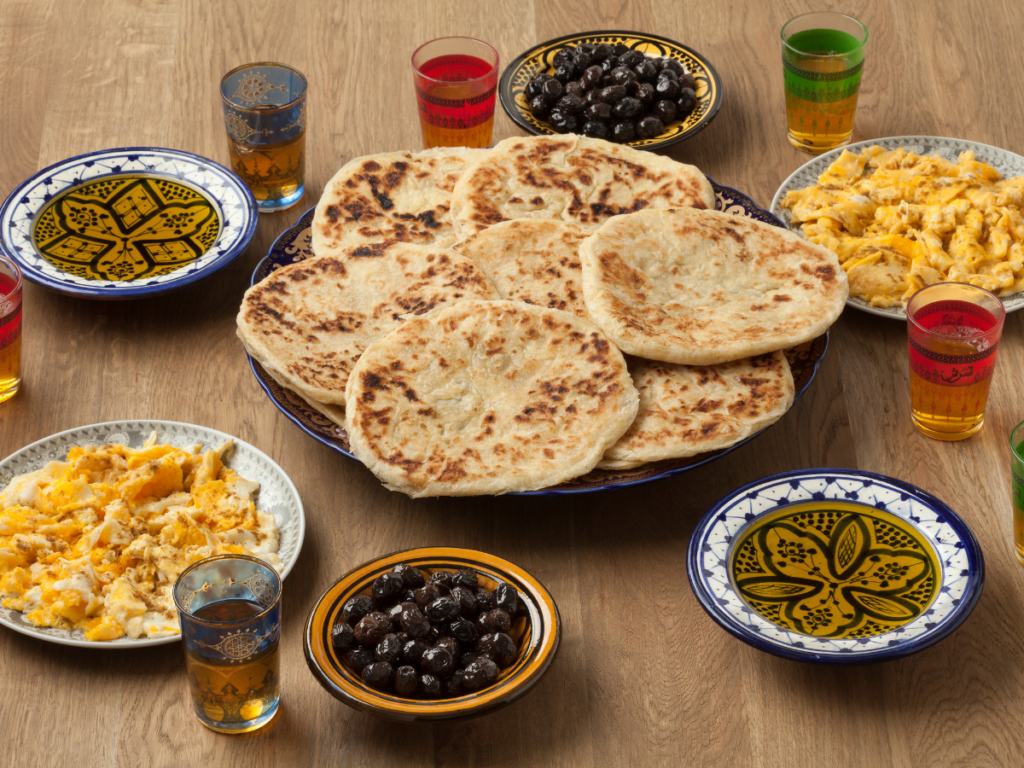
| Msemen and baghrir | Layered flatbread and semolina pancakes with honey, butter or amlou | Breakfast across the country |
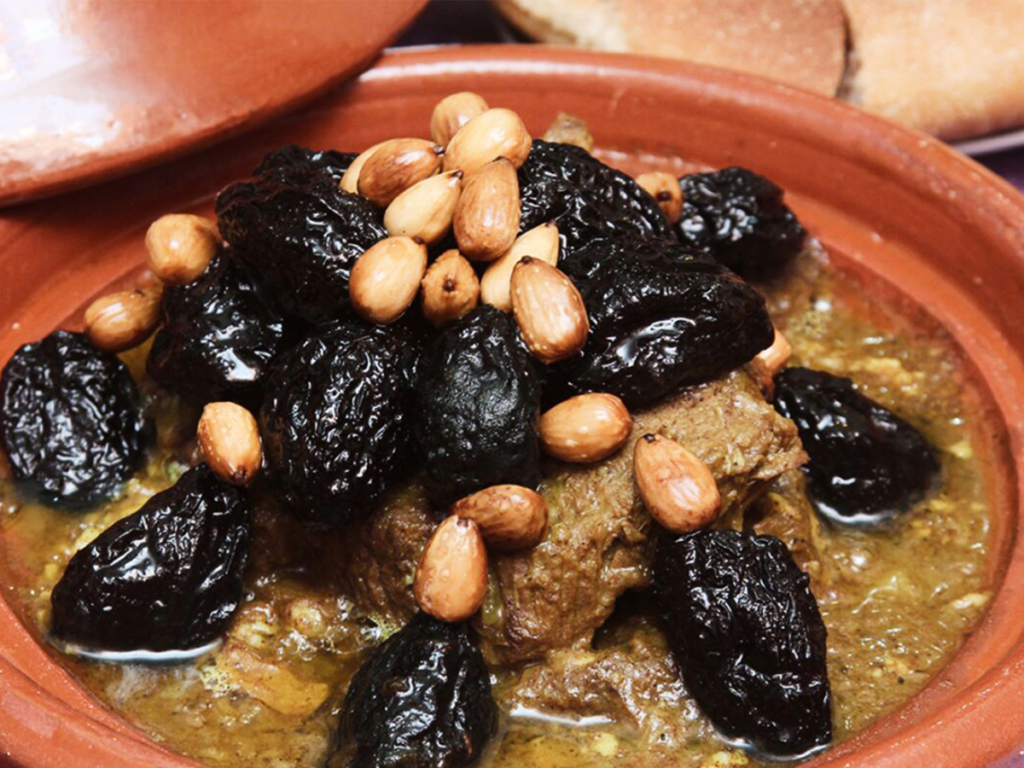
What to check, and how we help
- Alcohol: it is sold only in licensed hotels, bars, restaurants and some supermarkets. Many traditional riads and medina restaurants do not serve it, but policies vary, so we check property by property when you ask.
- Imported and packaged food: check labels and certification as you would at home, particularly for sweets, cheese and processed meat.
- Road days: lunch on long drives is usually at roadside restaurants serving grills, tagines and salads, and your driver knows reliable stops.
- Children and special diets: simple grilled chicken, omelettes, bread and fruit are available almost everywhere. For plant-based eating, see our guide to vegetarian and vegan food in Morocco.
For the stories behind the dishes, read our guide to traditional Moroccan and Berber food.
Are there mosques and prayer facilities in Moroccan cities?
Yes. Every Moroccan city and town, and most villages, have mosques within walking distance, and Muslim visitors are welcome to pray in them, including for Friday prayer. Many mosques have a women’s section. Official daily prayer times are published by Morocco’s Ministry of Habous and Islamic Affairs on habous.gov.ma, and most prayer apps follow them.
Mosques worth knowing on a Morocco holiday
- Hassan II Mosque, Casablanca: built on the Atlantic shore, with one of the tallest minarets in the world. It is one of the few mosques in Morocco that non-Muslim visitors can enter, on guided tours outside prayer times, which makes it ideal for mixed families and groups.
- Koutoubia Mosque, Marrakech: the twelfth-century minaret that has guided travellers to the medina for centuries, beside Jemaa el-Fna.
- Al-Qarawiyyin, Fes: founded in 859 by Fatima al-Fihri and still the spiritual heart of the Fes medina.
- Moulay Idriss Zerhoun: the hilltop town built around the shrine of Moulay Idriss I, close to Volubilis and Meknes.
A note for mixed groups: apart from the Hassan II Mosque, most mosques in Morocco are open only to Muslims, so plan an alternative visit for non-Muslim companions during prayer.
Praying on long road days
Routes to the Sahara involve full days on the road, for example Fes to Merzouga across the Middle Atlas, or the Dades Valley to Marrakech over the Tizi n’Tichka pass. On a private tour, share your prayer needs with your driver on the first morning so stops can be planned at town mosques or quiet places along the way. A compact travel prayer mat and a qibla app are useful for desert and mountain stretches.
Prayer at your riad or desert camp
Riads and hotels can usually provide a prayer mat and the qibla direction on request. In the Erg Chebbi dunes, praying Fajr in the stillness before sunrise can be one of the most memorable moments of the trip. If your tent has no private bathroom, ask the camp team for water for wudu the evening before.
What Muslim-friendly accommodation is there in Morocco?
Morocco has no national halal-certification scheme for hotels, so no agency can honestly promise certified halal accommodation everywhere. What you can find on halal holidays in Morocco are riads, hotels and camps whose facilities suit Muslim travellers: no alcohol, or alcohol kept away from shared areas, family rooms, private courtyards and staff who are happy to help with prayer, suhoor and iftar.
| Type of stay | What it offers Muslim travellers | Points to confirm |
|---|---|---|
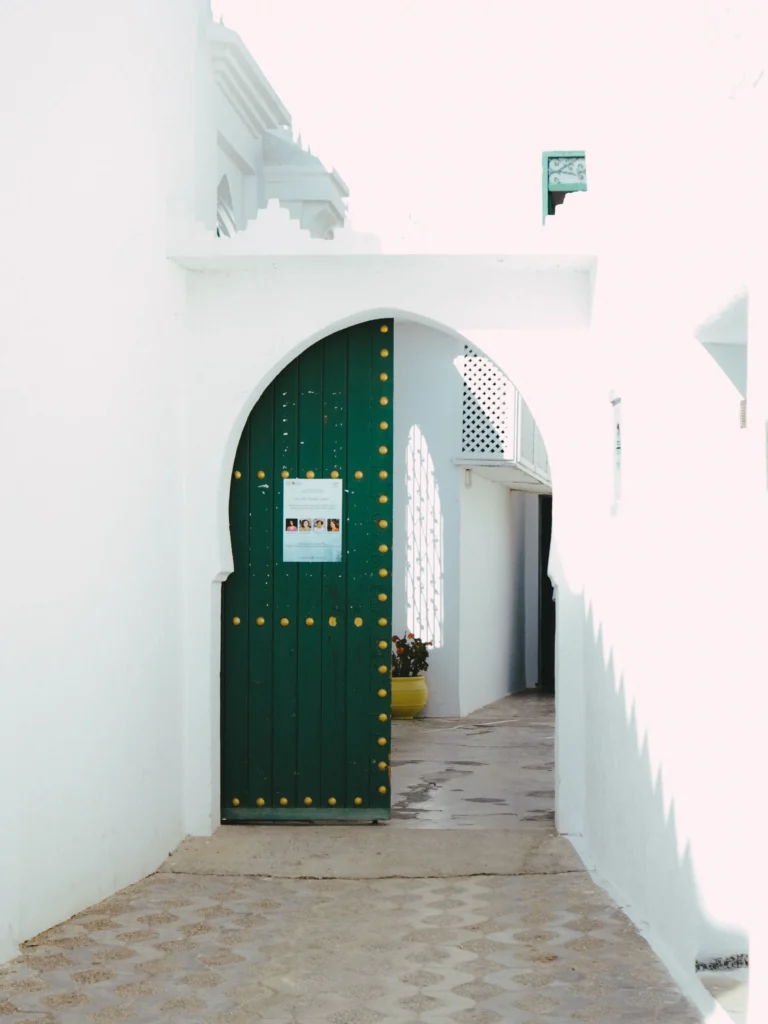
| Traditional riad | Small scale, inward-facing courtyard, family atmosphere; some are alcohol-free | Alcohol policy, stairs for small children or grandparents, family rooms |
| Whole-riad booking | Some small riads can be reserved in full for one family or group, for complete privacy | Minimum stay and availability on your dates |
| Hotel or resort | Lifts, pools, larger rooms and on-site restaurants | Whether alcohol is served in shared areas; pool and spa arrangements for women |
| Desert camp, Erg Chebbi | Private tents, dinner and breakfast, sunset and sunrise in the dunes | En-suite bathroom in the tent, meals, spacing between tents |
| Valley guesthouse, Dades or Todra | Quiet, family-run stays with home cooking | Heating in winter, room layout for your family |
Our Muslim-friendly Morocco travel guide includes a short checklist of questions to send any hotel before you book.
How can families and couples keep their privacy in Morocco?
Privacy is easiest on a private tour: your own vehicle, your own driver and accommodation chosen for your family rather than for a group. Within that, a few choices make a big difference.
For families
- Ask for family rooms, connecting rooms or, where available, a whole small riad.
- Visit busy medinas with a private licensed guide, so you move at your own pace instead of in a large group.
- Book a private hammam session at a riad or spa if you prefer not to use a public hammam.
- Build in afternoon rest in summer, when the south of Morocco is very hot.
For women travelling with family
Public hammams are separated by gender, either by section or by time. Hotel pools and spas differ in their arrangements, so ask about women-only times and swimwear policies before booking. Modest clothing is normal in Morocco and many Moroccan women wear a headscarf, so Muslim women usually feel at ease. Our guide to Morocco travel for women has more practical advice.
For married couples and honeymooners
Foreign couples are rarely asked for proof of marriage at check-in. Where one partner is Moroccan, some hotels may still ask for a marriage certificate, so carry a copy. Our guide to hotel rules for couples in Morocco explains the law and recent changes. For honeymoons, a private tent in the Erg Chebbi dunes and a small riad in Marrakech or Fes make a memorable, private pairing.
Which Moroccan cities should Muslim travellers visit?
Most halal holidays in Morocco combine the imperial cities with the north and the Sahara. Here is what each main destination offers, and how long to spend there.
| Destination | Highlights | Suggested time |
|---|---|---|
| Casablanca | Hassan II Mosque, Quartier Habous, the Corniche | Half a day to 1 day |
| Rabat | Hassan Tower, Mausoleum of Mohammed V, Kasbah of the Udayas | Half a day to 1 day |
| Tangier | Kasbah and medina, Cap Spartel, Caves of Hercules | 1 night |
| Chefchaouen | Blue medina, Kasbah, Spanish Mosque viewpoint | Half a day to 1 night |
| Fes and Meknes | Qarawiyyin quarter, madrasas, tanneries, Volubilis, Moulay Idriss | 2 to 3 nights |
| Marrakech | Koutoubia, Ben Youssef Madrasa, Bahia Palace, gardens, Jemaa el-Fna | 2 to 3 nights |
| Merzouga | Erg Chebbi dunes, camel trek, desert camp, Khamlia | 1 to 2 nights |
| Essaouira | Atlantic ramparts, fishing port, relaxed medina | 1 night |
Casablanca: where most journeys begin
Most international flights arrive at Mohammed V International Airport, which makes Casablanca the natural start for a longer trip. Its great sight is the Hassan II Mosque on the ocean. Nearby, the Quartier Habous, built in the twentieth century as a new medina, is a calm place to shop for books, olives, pastries and crafts. If you are starting here, our 12-day Morocco tour from Casablanca heads north to Tangier on the first day, and our page of Morocco tours from Casablanca lists shorter options. For a day in the city, see things to do in Casablanca.
Rabat: the calm capital
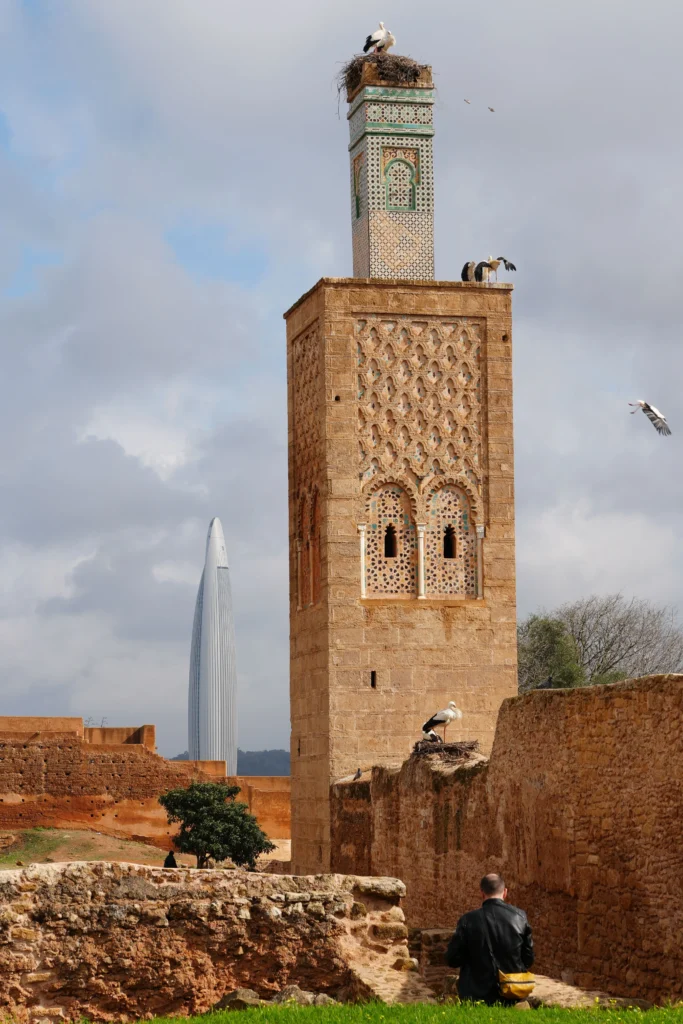
Morocco’s capital has green avenues and wide Atlantic views. Visit the Hassan Tower and the Mausoleum of Mohammed V beside it, then walk the blue-and-white lanes of the Kasbah of the Udayas above the river mouth. Rabat is not an overnight stop on our 12-day route; if you would like a visit on the drive north from Casablanca, ask us whether it fits your timing.
Tangier: the northern gateway
Tangier faces Spain across the Strait of Gibraltar. Walk the Kasbah and the medina, look for the tomb attributed to Ibn Battuta, the fourteenth-century traveller born in the city, and drive out to Cap Spartel and the Caves of Hercules, where the Atlantic meets the Mediterranean.
Chefchaouen: the blue town of the Rif
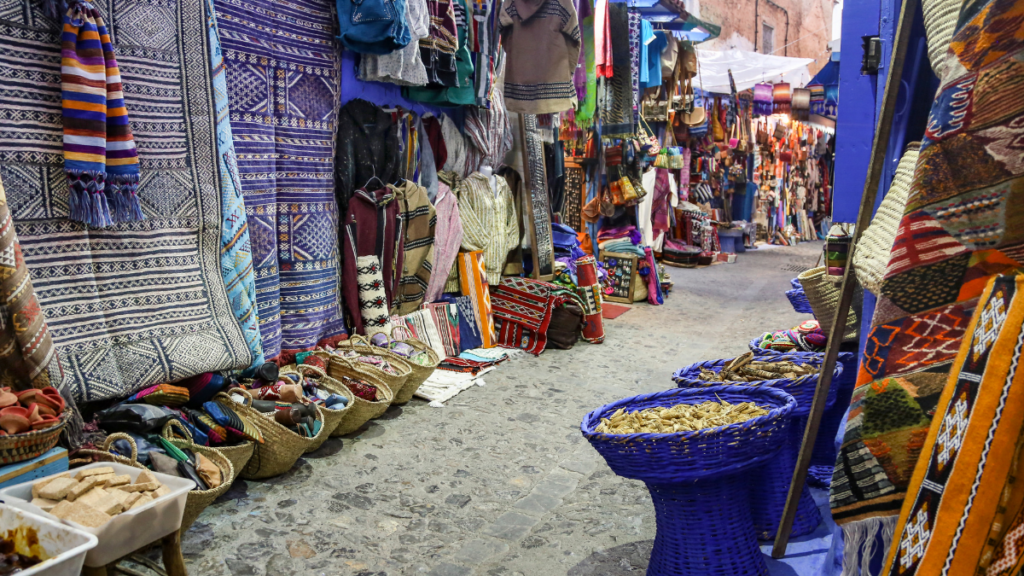
Founded in 1471 in the Rif Mountains, Chefchaouen is famous for its blue-washed lanes. It is compact and gentle for families: start at Outa el Hammam square and the Kasbah, then walk up to the Spanish Mosque viewpoint in the late afternoon for a view across the whole town.
Fes and Meknes: the heart of Islamic scholarship
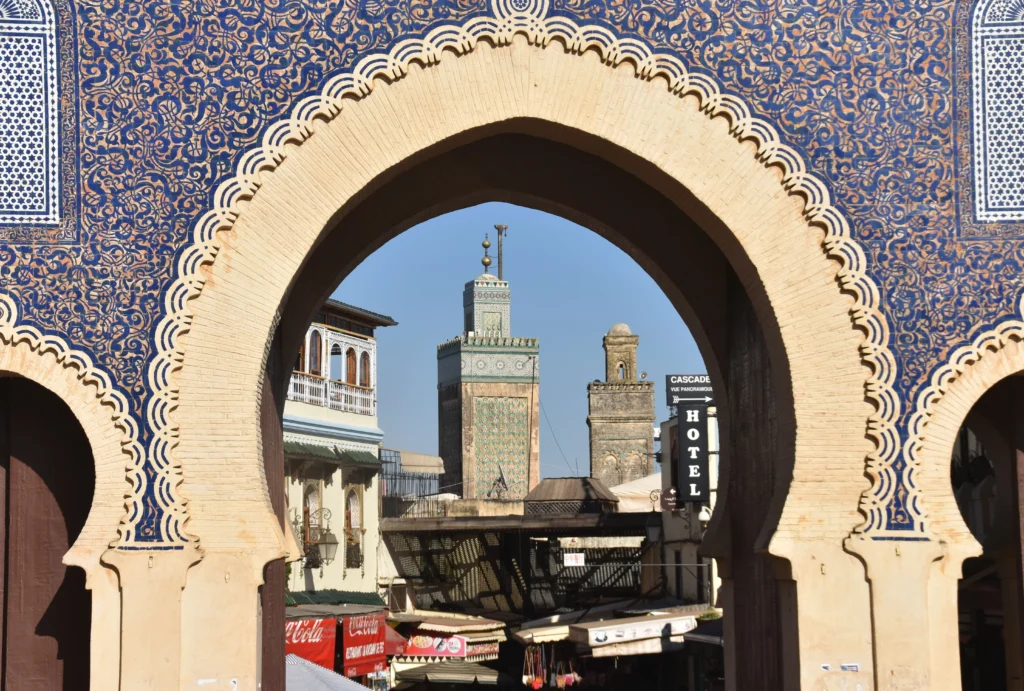
The medina of Fes el-Bali is a UNESCO World Heritage Site which UNESCO describes as one of the most extensive and best-conserved historic towns of the Arab-Muslim world. With a licensed local guide you can see the Bou Inania and Al-Attarine madrasas, the Zawiya of Moulay Idriss II, the tanneries from the surrounding terraces and the artisans’ quarters. A day trip covers Meknes, the Roman ruins of Volubilis and the holy town of Moulay Idriss Zerhoun; our private day trips from Fes explain the options.
Marrakech: family energy and gardens
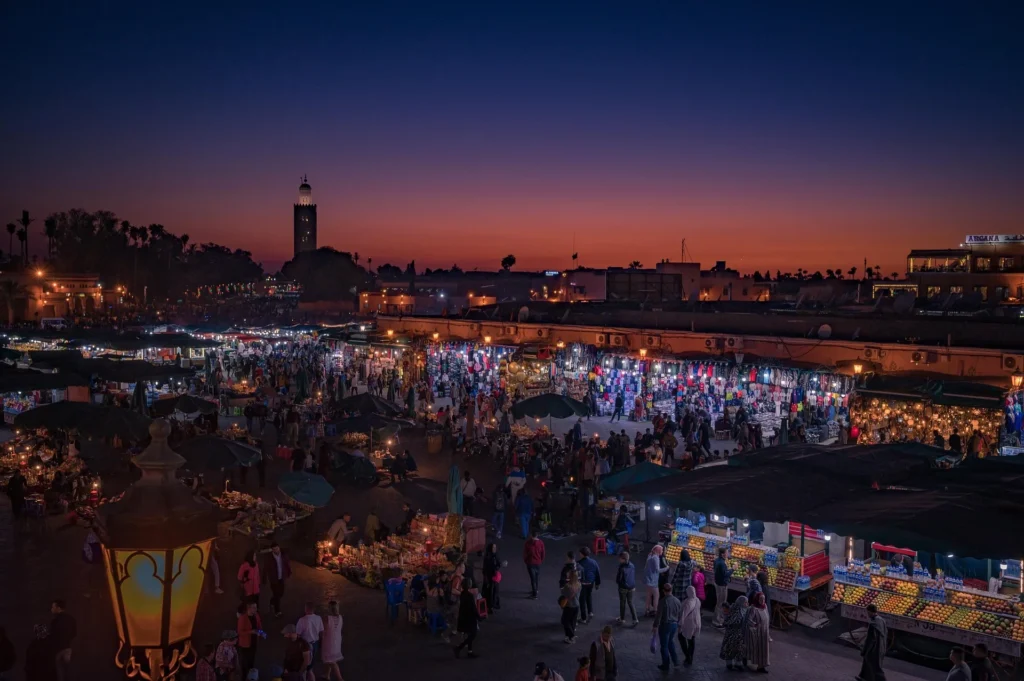
Marrakech is lively and full of family activities: the Koutoubia, Bahia Palace, the Ben Youssef Madrasa, the Majorelle and Menara gardens, and the evening food stalls of Jemaa el-Fna, where grills and tagines are prepared in front of you. Its medina is also on the UNESCO World Heritage List. If you travel with small children or elderly parents, choose a riad close to a main gate. For ideas, see our 21 best things to do in Marrakech.
Essaouira: a gentle coastal finish
On the Atlantic coast, Essaouira is the slow, breezy finale many families welcome after the desert: sea ramparts, a working fishing port where you can choose fish to be grilled, and a medina that is easy to walk with children.
Is Merzouga suitable for Muslim families?
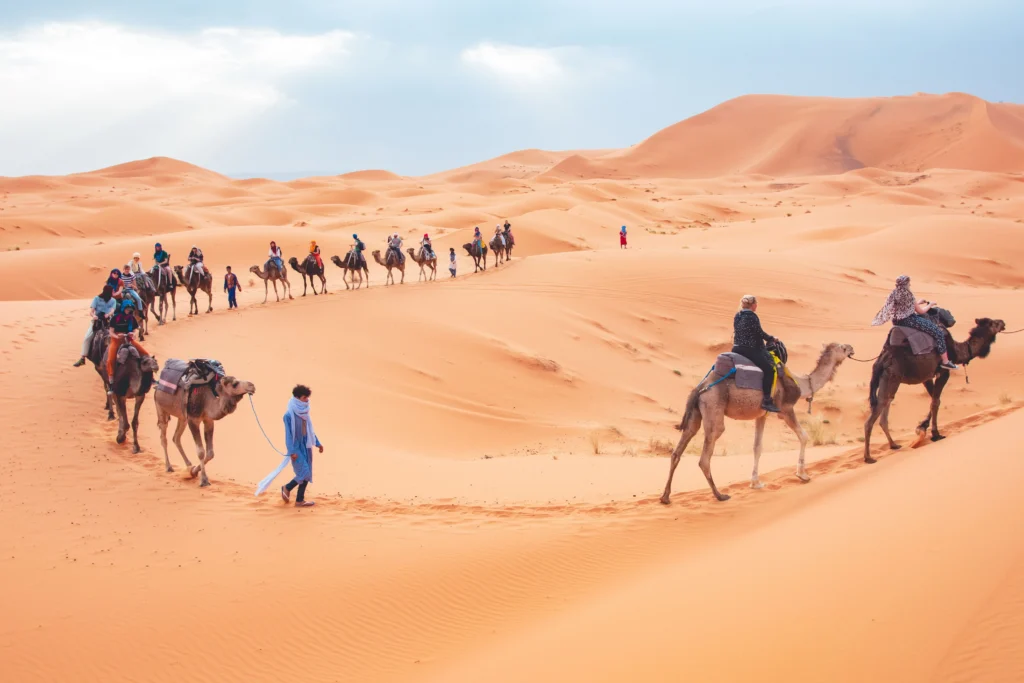
Yes. Merzouga, on the edge of the Erg Chebbi dunes in south-east Morocco, is one of the most rewarding stops for families: camel treks at sunset, a night in a desert camp, sandboarding for children and some of the clearest night skies in the country. Choose a camp with private tents and en-suite bathrooms if privacy matters to your family, and confirm meals in advance.
What a Sahara stay looks like
From Fes, the road crosses the Middle Atlas through Ifrane and the cedar forests of Azrou, then follows the Ziz Valley south to Merzouga. The next day you can visit Khamlia, a village known for Gnawa music, and the old trading town of Rissani, before a sunset camel trek into the dunes, dinner at camp and an early start to watch the sunrise. This is the rhythm of our private Morocco tour to the Sahara Desert from Casablanca, which spends one night in Merzouga and one in a desert camp.
Tips for a halal desert night
- Ask for a private tent with its own bathroom, which makes wudu and family privacy much easier.
- Camps usually serve soup, tagine, couscous, salads and fruit; mention any dietary needs when you book.
- Bring a light prayer mat and a qibla app, and a head torch for the walk back to your tent.
- Nights are cold from November to February, so pack warm layers; loose, covering clothing is also the most practical choice in sun and sand.
- For children, keep camel rides short and add sandboarding or a 4×4 drive around the dunes.
Read more in our Erg Chebbi travel guide, our comparison of standard and luxury desert camps and our answer to is Merzouga safe?
Beyond the dunes: Todra, Dades and Aït Ben Haddou
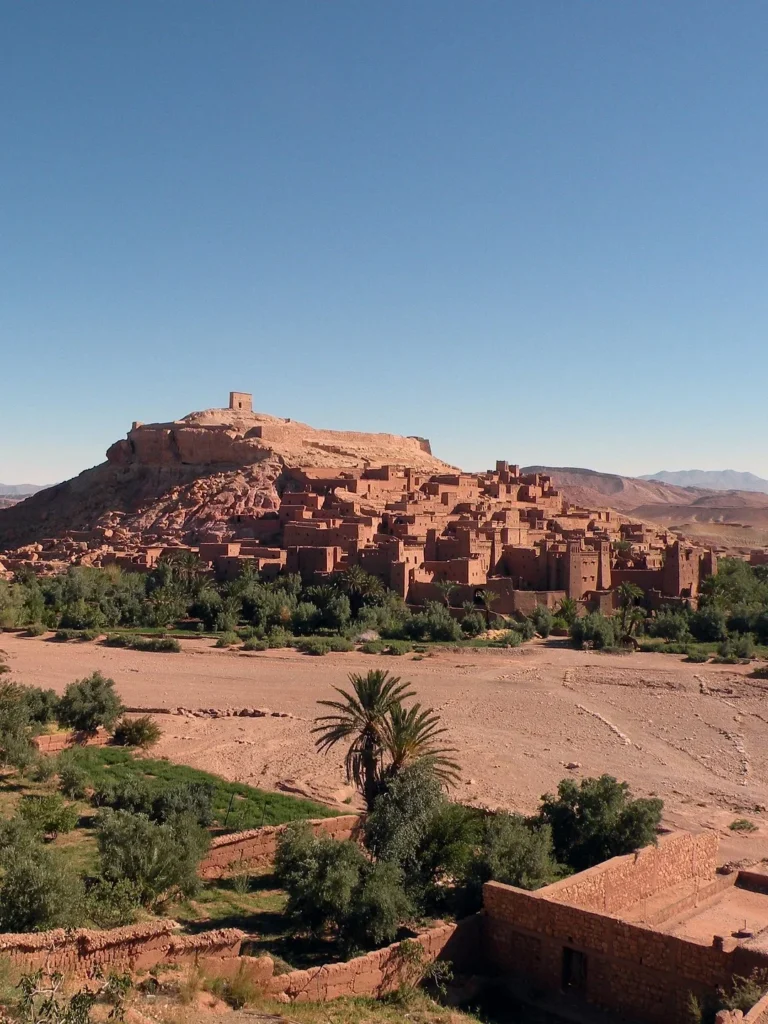
West of Merzouga, the road passes the towering walls of Todra Gorge and climbs into the Dades Valley, where a night in a quiet guesthouse breaks the drive. The next day follows the Road of a Thousand Kasbahs through the Valley of Roses and the Skoura palm oasis to Ouarzazate and the Ksar of Aït-Ben-Haddou, a fortified earthen village with its own mosque, before crossing the High Atlas to Marrakech.
What family-friendly cultural experiences can you enjoy in Morocco?
Moroccan culture is family-centred, and many of its traditions feel naturally familiar to Muslim families.
- Mint tea and hospitality: tea poured from a height and offered to guests in homes, shops and riads is the first welcome almost everywhere.
- Friday couscous: if you are in Morocco on a Friday, ask your riad whether couscous is on the menu after midday prayer.
- Crafts in Fes and Marrakech: zellige tilework, cedar carving, brass lanterns, leather and weaving, often made in workshops you can visit with a guide.
- Gnawa music in Khamlia: Gnawa, a spiritual music tradition with West African roots, is listed by UNESCO as intangible cultural heritage, and Khamlia near Merzouga is one of the easiest places to hear it.
- Hammam: the traditional steam bath is a weekly ritual for many Moroccan families; book a private session if you prefer.
- Cooking together: learning to make tagine or msemen is a favourite with older children; ask us whether a cooking experience can be added in Marrakech or Fes.
- Ramadan and Eid: travelling in Ramadan lets you share iftar and the lively evenings in the medinas. Ramadan 2027 is expected to begin around 8 February 2027, subject to the moon sighting; see our guide to Ramadan in Morocco for tourists.
For more family ideas, read Morocco with kids and our pick of the best places in Morocco for family holidays.
What practical advice should Muslim travellers know before visiting Morocco?
- Visas: entry rules depend on your passport; check our Morocco visa requirements guide and the official sources it links to.
- When to go: spring and autumn are the most comfortable seasons for a trip that combines cities and the Sahara. Summer is very hot in the south, and winter nights are cold in the desert and mountains. See the best time to visit Morocco.
- Fridays: mosques fill around midday and some shops close briefly, so plan sightseeing around Jumu’ah.
- Ramadan: expect shorter opening hours and a slower daytime pace; many local cafes close during the day while tourist restaurants and hotels usually stay open.
- Money: carry dirhams for souks, taxis and small restaurants; our guide to money in Morocco covers ATMs, cards and tipping.
- Dress: modest clothing is the norm and entirely appropriate; add warm layers for the desert and mountains.
- Greetings: as-salamu alaykum opens every conversation, and shukran (thank you) is always appreciated.
- Photography: ask before photographing people, especially women and children.
How do you plan a multi-destination halal holiday in Morocco?
Start with how many days you have, decide whether the Sahara is a must, and choose a start city that matches your flights. Then set your family’s non-negotiables, such as prayer stops, alcohol-free accommodation where possible, family rooms and the daily pace, before you book anything.
How many days do you need?
| Trip length | What fits comfortably | Example route |
|---|---|---|
| 5 to 6 days | The northern cities, or Marrakech with a short Sahara loop | 5-day northern Morocco itinerary |
| 7 to 8 days | Imperial cities plus Merzouga, at a brisker pace | 8-day trip from Casablanca |
| 12 days | The north, imperial cities, the Sahara, the kasbahs, Marrakech and the coast at a family pace | 12-day private tour from Casablanca |
| 14 days or more | More rest days, plus the Atlas Mountains or the far south | 2-week Morocco itinerary |
A sample 12-day route from Casablanca
This is the route of our 12-day, 11-night private tour, summarised night by night. It is a sample itinerary: on a private tour you can discuss changes to the pace, stops and accommodation before booking.
| Day | Route | Overnight |
|---|---|---|
| 1 | Casablanca to Tangier: Kasbah, medina, Cap Spartel | Tangier |
| 2 | Tangier to Chefchaouen to Fes | Fes |
| 3 | Volubilis and Meknes day trip | Fes |
| 4 | Private guided tour of the Fes medina | Fes |
| 5 | Ifrane, Azrou, Midelt and the Ziz Valley to Merzouga | Merzouga |
| 6 | Khamlia, Rissani and a sunset camel trek in Erg Chebbi | Desert camp |
| 7 | Sunrise, then Todra Gorge to the Dades Valley | Dades Valley |
| 8 | Rose Valley, Skoura, Ouarzazate, a visit to Aït Ben Haddou, then on to Marrakech | Marrakech |
| 9 | Private guided tour of Marrakech | Marrakech |
| 10 | Free day in Marrakech | Marrakech |
| 11 | Marrakech to Essaouira | Essaouira |
| 12 | Essaouira to Casablanca | End of tour |
Why the route suits Muslim families: it starts and ends in Casablanca, includes three nights each in Fes and Marrakech for unhurried prayer and rest, pairs a hotel night in Merzouga with a single desert-camp night, and finishes on the quiet Atlantic coast. Aït Ben Haddou is a sightseeing stop rather than an overnight, so the long day ends in Marrakech. Because the vehicle and driver are yours alone, prayer stops and meal breaks fit around your day rather than a group timetable.
Why travel privately?
- Prayer stops planned around your times, not a group schedule.
- Guidance on halal restaurants and reliable roadside stops.
- A pace that suits children and grandparents, with free time built in.
- Privacy in the vehicle and at the accommodation you choose.
- Officially licensed local guides in the Fes and Marrakech medinas.
If you would like to explore Morocco from Casablanca to Marrakech through the north and the Sahara, the 12-day route is the most complete option we publish. For other routes, compare our best Morocco itineraries, read how private tours with a driver work, or see the ways to travel from Casablanca to Marrakech directly.
What can Journey Via Morocco arrange for Muslim travellers?
We are a Moroccan company based in Marrakech, and we plan private tours and halal holidays in Morocco on the routes described in this guide. Here is what we can arrange, and what we cannot promise.
We can arrange
- A private vehicle and driver for your group only
- Prayer stops planned with your driver each day
- Advice on halal restaurants and roadside stops
- Requests for alcohol-free riads or hotels where suitable options exist on your dates
- Family rooms, connecting rooms or whole-riad bookings where available
- Private tents in the Erg Chebbi desert camp
- Officially licensed local guides in Fes and Marrakech
- Suhoor and iftar requests passed to your accommodation during Ramadan
Please note
- Our tours are not halal-certified, and Morocco has no national halal-certification scheme for hotels.
- Alcohol policies depend on each property. We confirm them in writing when you ask.
- Alcohol-free and whole-riad options vary by city and season and cannot be guaranteed everywhere.
- On the 12-day tour, lunches and most dinners are not included, so you choose where to eat; dinner and breakfast at the desert camp are included.
12 days · 11 nights · private
Discover Morocco on a 12-Day Private Journey from Casablanca
Explore Morocco’s imperial cities, northern landscapes, traditional villages and the golden dunes of the Sahara on a private journey designed around your travel experience.
- Tangier and Chefchaouen
- Fes, Meknes and Volubilis
- Merzouga and Erg Chebbi
- Todra, Dades and Aït Ben Haddou
- Marrakech and Essaouira
Frequently asked questions
Is Morocco a good destination for Muslim travellers?
Yes. Morocco is a Muslim-majority country where halal food is the everyday standard, mosques are found in every town and Islamic holidays shape the calendar. It also offers great variety in one trip, from the imperial cities and Chefchaouen to the Sahara.
Is halal food widely available in Morocco?
Yes. Meat served in Moroccan restaurants and sold by local butchers is halal as standard, and pork is not part of Moroccan cuisine. Check imported products and some international chains, and ask whether a hotel restaurant serves alcohol if that matters to you.
Are there mosques and prayer facilities in Moroccan cities?
Yes. Mosques are within walking distance almost everywhere, many with a women’s section, and Muslim visitors are welcome to pray. Official prayer times are published by the Ministry of Habous and Islamic Affairs, and riads and hotels can usually provide a prayer mat and the qibla direction.
Can Muslim families find private accommodation in Morocco?
Yes. Traditional riads built around private courtyards, family rooms and, in some cases, whole-riad bookings give families a high level of privacy. There is no national halal-certification scheme for hotels, so confirm alcohol policies and facilities with each property before booking.
Is Merzouga suitable for Muslim families?
Yes. Merzouga and the Erg Chebbi dunes are a family favourite for camel treks, sandboarding and nights under the stars. Choose a camp with private tents and en-suite bathrooms for privacy, confirm meals in advance and pack warm layers for winter nights.
Can I explore Morocco on a private 12-day tour from Casablanca?
Yes. Our 12-day private tour from Casablanca visits Tangier, Chefchaouen, Fes, Meknes and Volubilis, Merzouga, Todra Gorge, the Dades Valley, Aït Ben Haddou, Marrakech and Essaouira before returning to Casablanca. It lasts 12 days and 11 nights with a private driver, and the route can be adjusted before booking.
When is the best time for a halal holiday in Morocco?
Spring and autumn are the most comfortable seasons for a trip that combines cities and the Sahara. Travelling during Ramadan is rewarding for Muslim travellers but slower paced. Ramadan 2027 is expected to begin around 8 February 2027, depending on the moon sighting.