Last updated: 3 November 2026 · Written and reviewed by the Journey Via Morocco travel team. Advisories and conditions change, so check the official sources linked below before you travel.
For routes, weather and camps, see our full Merzouga desert guide and our private Marrakech tours to the dunes.
Is Merzouga safe for tourists? Yes. Merzouga is a small, quiet village at the edge of the Erg Chebbi dunes, and it welcomes visitors every day of the year. The risks here are not about crime: they are heat, cold desert nights, falls from camels, quad-bike accidents and the long road from Marrakech or Fes. Choose a reputable operator and plan around the season, and most of those risks disappear.
Merzouga and the Erg Chebbi dunes are the heart of our desert trips, and our drivers make the journey from Marrakech and Fes every week. This guide explains what official advice says, how to stay safe on the dunes and on a camel, what to expect in a desert camp, and how to choose a guide you can trust.
In this guide
- What official advice says
- Sahara Desert safety: heat, cold and sand
- Camel trekking safety
- Desert camp security and facilities
- Solo female travelers and families
- Marrakech to Merzouga road safety
- Choosing a reliable guide or operator
- Frequently asked questions
Is Merzouga safe? What official advice says
The US State Department rates Morocco at Level 2, “Exercise Increased Caution”, because of terrorism risk, and the UK FCDO advises vigilance in places popular with tourists. Neither issues a separate warning for Merzouga at the time of writing.
One geographic fact is worth knowing: Merzouga lies close to the Algerian border, and the land border between Morocco and Algeria has been closed since 1994. Desert excursions from Merzouga stay well inside Morocco on established routes. Never try to explore toward the border on your own, and stay on the routes your guide uses.
| Topic | Short answer | Type |
|---|---|---|
| US advisory for Morocco | Level 2, Exercise Increased Caution (terrorism) | Official fact |
| Merzouga-specific warning | None separate from the country-wide advice at the time of writing | Official fact |
| Algerian land border | Closed since 1994; tours stay on established routes inside Morocco | Fact |
| Main risks for visitors | Heat, cold nights, camel falls, quad bikes, long road journeys | Our team’s experience |
| Nearest hospitals | In Errachidia, about two to three hours by road; smaller clinics in Rissani and Erfoud | Practical fact |
Sahara Desert safety: heat, cold and sand
The desert itself is the main thing to respect. Conditions change dramatically through the year and through the day.
- Summer heat (June to August): afternoons can pass 40°C (104°F). Good operators schedule camel rides for late afternoon and early morning and keep the middle of the day for shade and rest.
- Winter nights (December to February): temperatures can drop close to freezing after sunset. Bring a warm jacket and hat even if the day is sunny.
- Sun: the reflection from the sand is intense at any time of year. A hat, sunglasses, high-factor sunscreen and a scarf to cover your face are essential.
- Wind and sand: sandstorms happen, especially in spring. A scarf (a Berber cheche) protects your nose and mouth; sunglasses protect your eyes.
- Water: drink more than you think you need; dehydration creeps up on visitors who are busy taking photos.
- Getting lost: the dunes look the same in every direction, and phone signal is patchy. Do not walk into the dunes alone, especially at night.
- Wildlife: scorpions and snakes live in the desert but are rarely seen around camps. Shake out your shoes in the morning and use a flashlight at night.
For month-by-month temperatures, see our Sahara desert weather guide.
Is camel trekking safe?
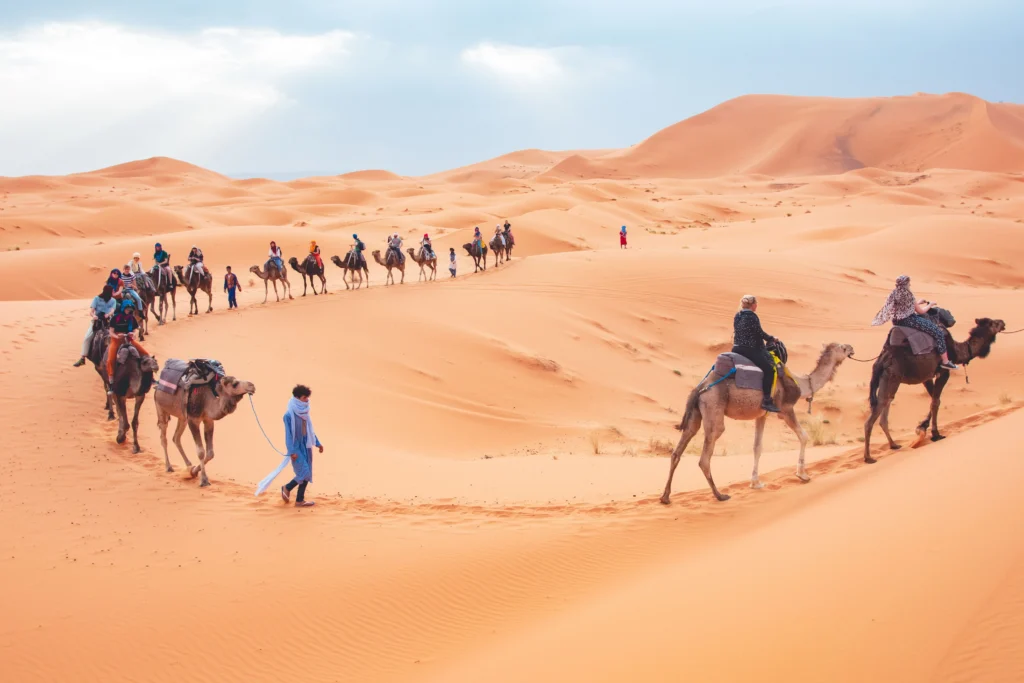
Yes, for most people. The camels used in Merzouga are dromedaries that walk in a line led on foot by a cameleer, at walking pace. The moments that need care are getting on and off:
- When the camel stands up, it rises back legs first, tipping you forward. Lean back and hold the handle firmly; when it kneels, do the same.
- Keep both hands free of cameras during standing and kneeling.
- Tell your guide about back problems, pregnancy or recent surgery; walking alongside or a 4×4 transfer to camp is always possible.
- Rides to camp usually last one to two hours. If you are nervous, ask for a shorter ride.
Animal welfare is part of safety: a healthy, well-treated camel is a calm camel. Reputable operators rest their animals, do not overload them, and avoid riding in the hottest hours.
Quad bikes, 4x4s and sandboarding
Quad biking on the dunes is popular, and it is where the most serious accidents tend to happen. Ride only with an operator that provides helmets and a guide, start slowly, and never ride after dark. On 4×4 excursions, wear a seatbelt; dune driving is bumpy. Sandboarding is safe if you choose a slope suited to your level. See our guide to the best desert activities in Merzouga.
Are desert camps in Merzouga safe?
Desert camps in Erg Chebbi are staffed overnight, set in established camp areas inside the dunes, and used by thousands of visitors a year. What varies a lot between camps is comfort and facilities:
| Camp type | Typical facilities | Good for |
|---|---|---|
| Standard camp | Shared or simple tents, shared toilets, blankets, dinner around a fire | Budget travelers and adventurous groups |
| Comfort camp | Private tents with beds, often private bathrooms, electric light | Couples and families |
| Luxury camp | Large private tents, en-suite bathrooms with hot water, heating or fans | Travelers wanting hotel-level comfort |

Our camp safety tips: keep valuables in a small bag that stays with you, bring a headlamp for night trips to the bathroom, charge devices when power is available (it may be limited at night), and tell staff if you need anything. Our guide to Sahara desert camping compares camp types in detail, and you can see what a high-end night looks like in our Merzouga luxury desert experience.
Is Merzouga safe for solo female travelers and families?
Solo female travelers
Many women travel to Merzouga alone or with friends. The practical steps that matter most are booking with a well-reviewed operator, asking for a private tent rather than a shared one, sharing your itinerary with someone at home, and arranging transport in advance rather than accepting lifts on arrival. Modest, loose clothing is also the most comfortable choice in the desert sun. Read our Morocco travel guide for women for more.
Families with children
Merzouga is a favorite with families. Children usually love the camels and sandboarding. Choose a camp with private bathrooms, avoid the summer heat, keep camel rides short for young children (a parent can ride with them or walk alongside), and keep the long driving days broken up with stops. Families often prefer a four-day trip from Marrakech for a gentler pace.
Is the road from Marrakech to Merzouga safe?
The road is paved all the way, and thousands of tourist vehicles use it every week. It is, however, long: about nine to ten hours of driving, usually split over two days with a night in the Dades Valley. The main hazards are:
- The Tizi n’Tichka pass over the High Atlas: winding, with trucks, and occasional snow and closures in winter.
- Driving after dark in rural areas, where pedestrians, animals and poorly lit vehicles share the road.
- Fatigue on the long, straight stretches toward Rissani and Merzouga.
Traveling with an experienced private driver who knows the route, drives in daylight and builds in rest stops is the safest way to reach the desert. From Fes, the journey is shorter, at around seven to eight hours. If you are flying, our guide to the closest airport to the Sahara compares the options.
How to choose a reliable guide or tour operator
- Book before you arrive rather than with someone who approaches you in Merzouga or on the road.
- Check recent reviews on independent platforms, and look for comments about drivers, camps and camels.
- Ask exactly what is included: camp type, private or shared tent, bathroom, meals, the length of the camel ride, and who drives.
- Ask about safety equipment for quads and 4x4s, and how the camp handles emergencies.
- Be wary of very cheap offers, which often mean shared tents, long detours to shops, or overloaded group transport.
- Keep the operator’s phone number and your camp’s location saved offline.
Our own desert trips include the 3-day Marrakech to Merzouga tour, the private 4-day Marrakech to Merzouga tour, the 2-day private Fez to Merzouga tour and our full range of Marrakech desert tours.
Practical safety checklist for Merzouga
- Check the latest US or UK advice before you go.
- Pack a hat, sunglasses, scarf, sunscreen, a warm layer and a headlamp.
- Carry water and drink often.
- Never walk into the dunes alone at night.
- Ride quads only with helmets, a guide and in daylight.
- Make sure your travel insurance covers adventure activities and medical evacuation; see our insurance guide.
- Expect patchy phone signal; see our eSIM and coverage guide.
- Save the emergency numbers: gendarmerie 177 (rural areas), ambulance and fire 15.
Frequently asked questions about Merzouga safety
Is it safe to sleep in the Sahara Desert in Morocco?
Yes. Desert camps in Erg Chebbi are staffed overnight and host visitors every night of the year. The practical concerns are comfort and temperature, so choose a camp type that suits you and bring warm clothing in winter.
Is Merzouga close to the Algerian border?
Yes, Merzouga is near the border, but the land border between Morocco and Algeria has been closed since 1994. Tours stay on established routes inside Morocco, and visitors should not head toward the border independently.
Can children ride camels in Merzouga?
Usually yes, with a parent or with the cameleer walking close by. For very young children, a short ride or a 4×4 transfer to camp is the more comfortable option. Ask your operator in advance.
When is the safest time to visit Merzouga?
Spring (March to May) and autumn (September to November) have the most comfortable temperatures. Summer brings extreme heat, and winter brings cold nights, so both need more preparation rather than being unsafe.
Do I need a guide in the Merzouga desert?
For anything beyond the edge of the dunes, yes. A local guide knows the routes, the camps and the conditions, and is the main safeguard against getting lost or caught out by heat or wind.
Official sources
Learn more about the dunes themselves in our guide to the Erg Chebbi dunes of Merzouga, or contact our team to plan a safe, comfortable desert trip.