
An 8 day Morocco trip from Casablanca to Marrakech lets you cross the country in one direction: from the Atlantic coast to the imperial cities of Rabat and Fes, over the Middle Atlas to the Sahara dunes at Merzouga, then west through the Dades Valley and Aït Ben Haddou before finishing in Marrakech. You don’t need to double back, and you can fly into Casablanca and out of Marrakech.
Is eight days enough? Yes, for a first look at Morocco’s cities, mountains and desert. The catch is that the route covers roughly 1,300 to 1,400 km by road (our estimate), and three of the days involve long drives. This guide gives you a realistic day-by-day plan, what each driving day actually involves, and where it makes sense to slow down.
The Route at a Glance
- Start: Casablanca (Mohammed V International Airport, CMN)
- Finish: Marrakech (Marrakech-Menara Airport, RAK)
- Length: 8 days, 7 nights
- Overnights: Casablanca (1), Fes (2), Merzouga area (1), desert camp (1), Dades Valley (1), Marrakech (1)
- Main stops: Rabat, the Fes medina, Ifrane and the Middle Atlas, the Ziz Valley, the Erg Chebbi dunes, Todra Gorge, the Dades Valley, Aït Ben Haddou and the Tizi n’Tichka pass
- Best for: first-time visitors who want cities, mountains and the Sahara in one trip, and who don’t mind several long road days
Day-by-Day Distances and Driving Times
| Day | Route | Approx. distance | Driving time without stops | Realistic day with stops |
|---|---|---|---|---|
| 1 | Arrive in Casablanca | — | — | Half day in the city |
| 2 | Casablanca → Rabat → Fes | ~290 km (about 90 + 200) | ~3–3.5 h | Full day including Rabat |
| 3 | Fes | — | — | Full day in the medina |
| 4 | Fes → Ifrane → Ziz Valley → Merzouga | ~460–470 km | ~7.5–8 h | About 8–10 h |
| 5 | Merzouga and Erg Chebbi | Short local transfers | — | Desert day, night in camp |
| 6 | Merzouga → Todra Gorge → Dades Valley | ~250–260 km | ~4 h | About 6–7 h |
| 7 | Dades → Ouarzazate → Aït Ben Haddou → Marrakech | ~310 km by the direct road, plus the Aït Ben Haddou detour | ~6 h | 8 h or more |
| 8 | Marrakech, then departure | — | — | Depends on your flight |
All figures are approximate. Driving times do not include sightseeing, and real travel times depend on traffic, roadworks, weather and your exact start and end points. Published estimates for the same road can differ by an hour or more. For more routes, see our Morocco driving times and distances guide.
Day-by-Day 8 Day Morocco Itinerary
Day 1: Arrive in Casablanca
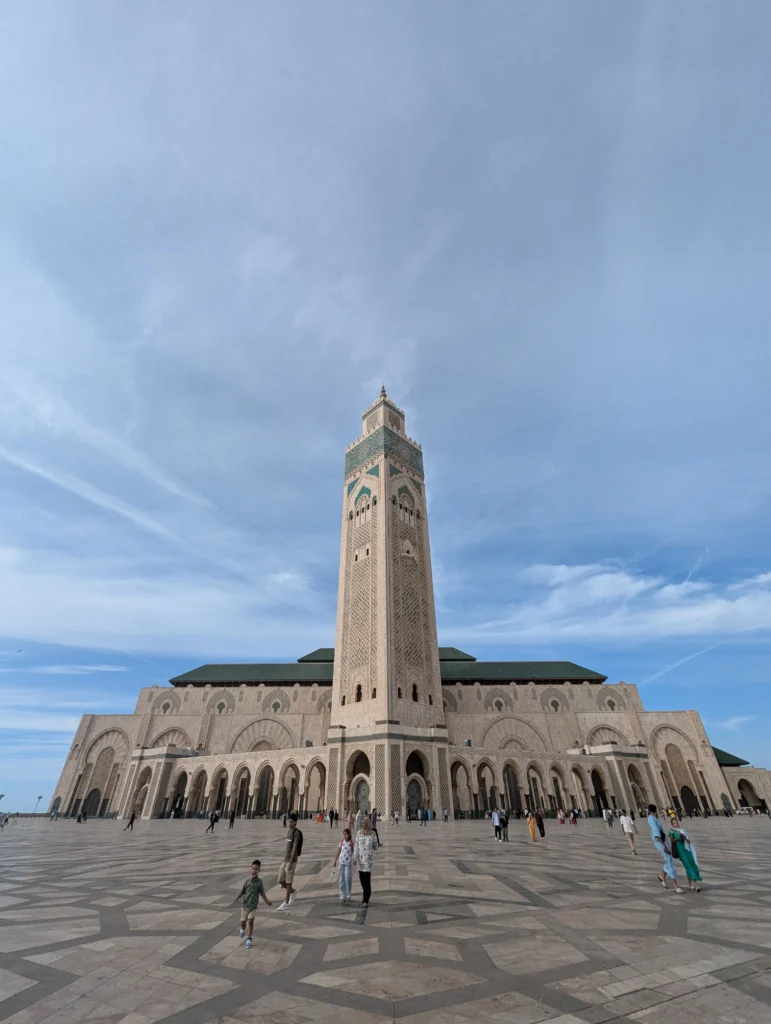
Casablanca is Morocco’s largest city and the place where many long-haul flights land. If you arrive early enough, the obvious sight is the Hassan II Mosque on the ocean front. It is one of the very few mosques in Morocco that non-Muslim visitors can enter, and only on a guided tour held outside prayer times. Tour times change with the season and during Ramadan, so check the current schedule before you plan your afternoon. Shoulders and knees must be covered, and women are asked to cover their hair inside.
If your flight lands in the evening, don’t try to sightsee. A good night’s sleep sets you up for the long days ahead.
Overnight: Casablanca
Day 2: Casablanca to Rabat and Fes
Rabat is only about 90 km from Casablanca, around an hour on the A1 motorway, although traffic near Mohammedia can slow you down at peak times. Morocco’s capital is calmer than Casablanca, and its main sights sit close together:
- Kasbah of the Udayas: a walled quarter above the river mouth, with whitewashed lanes and views over the Atlantic
- Hassan Tower: the unfinished 12th-century minaret, standing among rows of column bases
- Mausoleum of Mohammed V: next to the Hassan Tower, with ceremonial guards at the entrance
Rabat’s historic centre and modern city are listed together by UNESCO as Rabat, Modern Capital and Historic City: a Shared Heritage (2012).
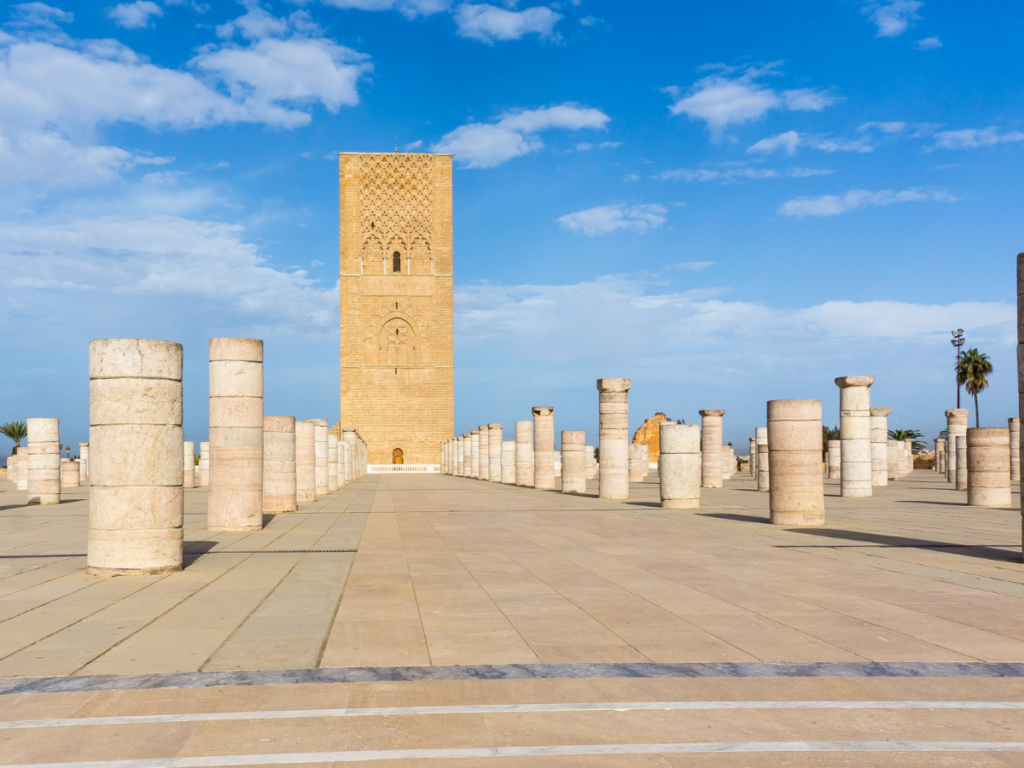
From Rabat, the road to Fes is around 200 km and usually takes 2 to 2.5 hours. It is mostly on the A2, which bypasses Meknes. If Meknes or the Roman site of Volubilis matters to you, you’ll need extra time, which is hard to find on an 8-day plan (see “How to Adjust This Itinerary” below).
Overnight: Fes
Day 3: A Full Day in the Fes Medina
The medina of Fes has been a UNESCO World Heritage Site since 1981. Its lanes are narrow and confusing, which is why most first-time visitors book an official licensed local guide for at least half a day.
Typical highlights include:
- The gates of the Royal Palace (Dar al-Makhzen), seen from the outside
- The Mellah, the historic Jewish quarter
- Bou Inania Madrasa: one of the few religious buildings in Fes that non-Muslim visitors can enter. You can see the courtyard and carved woodwork, but not the prayer hall. There is a small entry fee, and opening hours should be checked locally
- The leather tanneries, usually viewed from the terraces of the surrounding leather shops
- Artisan quarters for metalwork, weaving and ceramics

Two nights in Fes means you only unpack once, and it gives you a slower afternoon to rest before the longest drive of the trip.
Overnight: Fes
Day 4: Fes to Merzouga via the Middle Atlas
This is the longest day of the itinerary, about 460–470 km. Map driving time is roughly 7.5 to 8 hours without stops. With fuel, meal and photo stops, plan for a long day of about 8 to 10 hours on the road. The exact time depends on traffic, road conditions and how often you stop. Start early.
The route climbs into the Middle Atlas through Ifrane, a mountain town known for its alpine-style architecture, then passes the cedar forests near Azrou, where you may see Barbary macaques. Keep your distance and don’t feed them. The landscape then opens onto the high plateau around Midelt before dropping into the Ziz Valley, a long green ribbon of palm groves, and on through Errachidia, Erfoud and Rissani to Merzouga.
Because you arrive late in the day, this plan spends the first night in a hotel or guesthouse near the dunes and keeps the desert camp for the next evening. It means a calmer arrival and a full day in the desert.
Overnight: Merzouga area (hotel or guesthouse)
For more detail on this road, see our Fes to Merzouga to Marrakech route guide.
Day 5: A Day in the Sahara at Erg Chebbi
Erg Chebbi is Morocco’s best-known sand sea, and its highest dunes are commonly described as rising to around 150 metres. With a full day here you can take a 4×4 drive around the edge of the dunes, visit nearby villages and the market town of Rissani, or simply rest through the hottest hours.
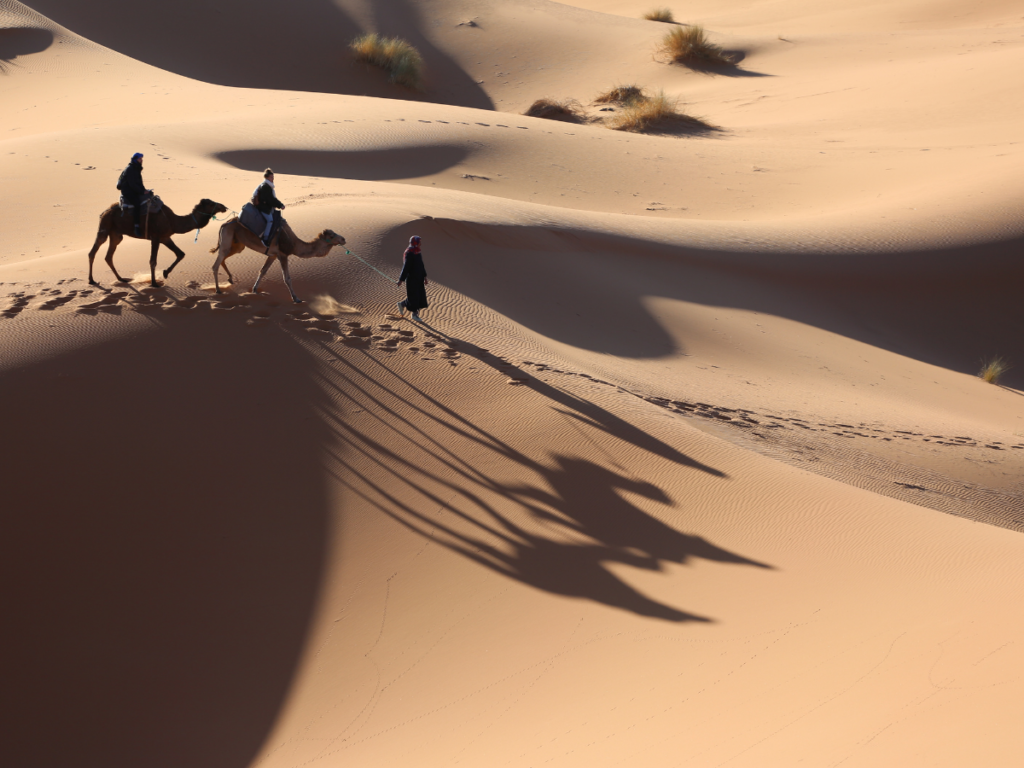
In the late afternoon, ride a camel (or take a 4×4 transfer if you prefer not to ride) to a desert camp for sunset, dinner and a night under a dark sky.
Desert camps range from simple tents with shared facilities to larger tents with private bathrooms. What a camp includes varies between camps and categories, so if you need a private bathroom, electricity or heating, confirm it for the specific camp and dates. Pack a small overnight bag; your main luggage can stay in the vehicle.
Overnight: desert camp at Erg Chebbi
Read more in our Erg Chebbi dunes guide and our guide on how to choose a Merzouga desert tour.
Day 6: Merzouga to Todra Gorge and the Dades Valley
If you’re up early, the dunes at sunrise are worth it. After breakfast, the road heads west for roughly 250–260 km. That is about 4 hours of driving, but closer to 6 to 7 hours with stops.
The main stop is Todra Gorge, just outside Tinghir, where sheer limestone walls close in around a narrow river. A walk along the canyon floor takes 30 to 60 minutes. You then continue to the Dades Valley, an area of kasbahs, oases and rock formations, for the night.
Overnight: Dades Valley
Day 7: Dades Valley to Aït Ben Haddou and Marrakech
Another long day: around 310 km to Marrakech by the direct road, more with the short detour to Aït Ben Haddou. That is about 6 hours of driving, and realistically 8 hours or more with stops.
You pass through the Skoura palm oasis and Ouarzazate, known for its film studios, before reaching Aït Ben Haddou. This fortified earthen village (ksar) was inscribed as a UNESCO World Heritage Site in 1987, and you’ll want time to walk up through it. The road then crosses the High Atlas by the Tizi n’Tichka pass, at about 2,260 metres, with many hairpin bends, before descending to Marrakech in the evening. In winter, snow can affect the pass, so check conditions the day before.
Overnight: Marrakech
Day 8: Marrakech and Departure
How much you see depends on your flight. With a late departure, a guided walk can cover Jemaa el-Fnaa square, the souks and a historic palace or garden. The Koutoubia Mosque can be admired from outside but is not open to non-Muslim visitors. The Marrakech medina has been a UNESCO World Heritage Site since 1985.
If your flight is early, plan a direct airport transfer. Better still, consider adding a night (see below).
Is 8 Days Enough for This Route?
Yes for a first visit, but it is an active itinerary rather than a relaxing one. Days 4, 6 and 7 each involve 6 to 10 hours on the road including stops, and you have only one full day in Fes, one in the desert, and a partial day in Marrakech.
Eight days works well if:
- You want to see a wide variety in one trip and don’t mind long drives
- You can arrive in Casablanca and leave from Marrakech
- You are happy with short visits to Rabat and Marrakech
Consider 9 or 10 days if:
- You want a full day in Marrakech, or two nights in the desert
- You’re travelling with young children or anyone who finds long car journeys hard
- You want to add Chefchaouen, Meknes or Volubilis
Compare this with our 7 days in Morocco itinerary and our 10 day Morocco trip itinerary.
How to Adjust This Itinerary
Add a Ninth Day
The easiest improvement is a second night in Marrakech. It turns Day 8 from a rushed morning into a proper day in the city.
Add Chefchaouen
The blue town of Chefchaouen is about 195–200 km from Fes. Adding it realistically costs two extra days. If northern Morocco is a priority, see our 6-day itinerary from Casablanca via Chefchaouen, Fes and Merzouga.
Start in Marrakech Instead
If your flights go in and out of Marrakech, a round trip from Marrakech avoids the one-way logistics. See our 8 day Morocco trip itinerary from Marrakech and our guide on whether to start in Marrakech or Casablanca.
Travel the First Part by Train
Trains connect Casablanca, Rabat and Fes. Some travellers take the train for the first leg and start a private driver or tour in Fes. South of Fes, the desert and the Dades Valley are much easier with a car and driver. See how to get around Morocco.
Practical Tips for an 8 Day Morocco Trip from Casablanca
Book Open-Jaw Flights
Flying into Casablanca and out of Marrakech is what makes this route work without backtracking. Check the cost of an open-jaw ticket before you settle on the route.
Plan Around the Long Driving Days
Start early on Days 4, 6 and 7, carry water and snacks, and don’t schedule anything important for the evenings you arrive. Winter days are shorter, which matters on these long drives.
Pack for Very Different Climates
You’ll go from the Atlantic coast to a mountain pass above 2,000 metres and a desert where nights can be cold, especially from late autumn to early spring. Bring layers, a warm jacket for evenings, sun protection and comfortable closed shoes. Modest clothing (shoulders and knees covered) is appropriate in medinas and required for the Hassan II Mosque.
Cash and Connectivity
ATMs are easy to find in Casablanca, Rabat, Fes and Marrakech. Carry some cash in dirhams for small purchases, cafés and rural stops along the southern route, where card acceptance is less certain. Mobile coverage can be patchy on mountain roads and around the dunes.
Check Dates and Opening Times
Opening hours for mosques, madrasas and palaces can change, especially on Fridays and during Ramadan. Ramadan 2027 is provisionally expected to fall between early February and early March 2027. The exact start and end dates follow the lunar calendar and are only confirmed by official announcements shortly beforehand, so check before you book. Travel is still possible during Ramadan, with some changes to daytime opening hours and services.
Best Time for This Route
Spring (March to May) and autumn (September to November) are generally the most comfortable months for a trip that combines cities, mountains and the Sahara. Summer is very hot in the desert and southern valleys, so plan early starts. Winter brings cold nights in Merzouga and the mountains, and occasional snow on the Middle Atlas and Tizi n’Tichka. The days are usually clear.
For month-by-month detail, see our guides to the best time to visit Morocco and the best time to visit the Sahara.
How This Itinerary Compares with Our Private 8-Day Tour
If you’d rather not organise drivers, hotels and the desert camp yourself, our private 8-Day Morocco Luxury Desert Tour from Casablanca covers most of the same route. It isn’t identical:
| This itinerary | Our 8-day private tour (sample route) | |
|---|---|---|
| Day 1 | Night in Casablanca | Casablanca sightseeing, then drive to Fes the same day |
| Rabat | Half-day stop on Day 2 | Not included in the sample route |
| Fes | Full guided day | Full guided day |
| Desert | Hotel night near the dunes, then one camp night | Hotel night near the dunes, then one camp night |
| Marrakech | Partial day on Day 8 | Full guided day on Day 7 |
| Ends in | Marrakech | Transfer back to Casablanca (about 240 km, 3–4 hours) |
The itineraries on our website are sample routes and can be adjusted, for example to add Rabat or to finish in Marrakech. Inclusions are listed on the tour page, and deposit and cancellation terms are in our Booking & Payment Policy and Cancellation Policy.
Frequently Asked Questions
Is 8 days enough to see Morocco from Casablanca?
It is enough for a first introduction that covers an imperial city, the Sahara and the High Atlas. Expect three long driving days. If you want a slower pace or more time in Marrakech, plan 9 or 10 days.
How far is Fes from Merzouga?
About 460 to 470 km. Map driving time is roughly 7.5 to 8 hours without stops; with stops, plan for about 8 to 10 hours on the road. Sightseeing time is extra and conditions vary.
Can I do this route in reverse, from Marrakech to Casablanca?
Yes. The same stops work in reverse, ending with Fes, Rabat and Casablanca. Check which direction gives you better flight times.
Do I need a 4×4 for this itinerary?
No. The main roads on this route are paved. A 4×4 is only needed for tracks into the dunes, which camps and local drivers arrange.
Can I see Chefchaouen on an 8 day trip from Casablanca?
Not comfortably on this route. Chefchaouen adds about two days. Choose a northern route instead, or extend the trip to 10 days.
Can I use public transport for this itinerary?
Partly. Trains run between Casablanca, Rabat and Fes. South of Fes, connections are slower and less frequent, so most travellers use a private driver or a tour for the desert section.
How much does an 8 day Morocco trip from Casablanca cost?
It depends on the number of travellers, the season, accommodation category, desert camp type, guides and transport. There is no reliable single price, so ask for a personalised quote based on your dates.
Plan Your 8 day Morocco trip from Casablanca
If you’d like help turning this itinerary into a private trip, send us your dates, the number of travellers and the kind of accommodation you prefer. We’ll suggest a route that fits.
- See the private 8-Day Morocco Luxury Desert Tour from Casablanca
- Browse all Morocco tours from Casablanca
- Message us on WhatsApp
Distances, driving times and opening hours are approximate and can change. Check current conditions before you travel.
