
“We’re not married. Will a riad in Marrakech let us share a room?” It is one of the most common questions our team receives, and the answers you find online are often outdated or confused. For Morocco travel, unmarried couple status is usually a non-issue for two foreign visitors, but the rules and the reality get more complicated when one partner is Moroccan.
Below, our team in Marrakech explains what the law says, how hotels and riads actually behave in 2026, what changes for mixed couples with a Moroccan partner, and how to handle public affection respectfully. We are a travel agency, not lawyers, so we flag where things are unclear and point you to official sources. Rules and their enforcement can change, so always check current advice before you travel.
Can unmarried couples share a hotel room in Morocco? If both partners are foreign nationals, yes: hotels, riads and desert camps routinely accommodate unmarried foreign couples and rarely ask for a marriage certificate. When one partner is a Moroccan national, some hotels may still ask for proof of marriage, although official statements since 2024 say they should not.
What the law says
Article 490 of the Moroccan Penal Code criminalizes sexual relations between unmarried men and women, with penalties of one month to one year in prison. Reform of this article has been debated in parliament and in the media for years, but as of late 2026 it remains in the penal code.
In practice, the law is not applied to foreign tourists sharing a hotel room. Historically, the hotel rule that grew out of it was aimed at Moroccan couples: hotel staff asked Moroccan guests checking in together for an “acte de mariage” (marriage contract). Foreign visitors were simply not part of that check. Several government sources reflect this. Australia’s Smartraveller page for Morocco notes that couples may need to show proof of marriage to share accommodation, and the UK government’s local laws and customs advice for Morocco is worth reading for the latest wording.
What changed in 2024
In 2024, Moroccan media widely reported that security services had informally dropped the requirement for hotels to see a marriage certificate, and Justice Minister Abdellatif Ouahbi said publicly that hotel staff have no authority to ask guests about their marital status. However, these were statements and verbal directives, not a change to the penal code. Moroccan press reports in 2025 still described hotels that remain cautious, especially smaller properties and some hotels outside the main tourist cities.
Morocco travel, unmarried couple scenarios: three situations
Your experience depends almost entirely on the nationalities in your couple. Here is how it typically works on the ground, based on what we see when we book hotels for our guests:
| Couple | What usually happens at check-in | Our advice |
|---|---|---|
| Both partners foreign (any nationality, non-Moroccan) | Passports are registered; no questions about marriage | Book a double room as normal |
| One Moroccan partner (including dual nationals traveling on a Moroccan ID) | Some hotels may ask for a marriage contract; practice varies by property | Confirm in writing with the hotel before booking |
| Both partners Moroccan | Policy has officially relaxed, but some hotels still ask | Choose larger or international hotels and confirm in advance |
| Same-sex couple (foreign) | Usually booked without questions as a double or twin | Be discreet in public; see the note below |
Note that dual nationals are generally treated as Moroccan inside Morocco. If you hold Moroccan and another nationality and you check in with your Moroccan CIN (national ID card), staff may apply the same practice as for any Moroccan guest.
Mixed couples with a Moroccan partner
This is where we recommend the most preparation. Many couples of a foreign partner and a Moroccan partner travel without any problem, and international chain hotels in Marrakech, Casablanca, Rabat and Tangier are generally used to them. But because the 2024 change was informal, you may still meet a receptionist at a small riad or guesthouse who asks for a marriage certificate, or who politely says the property cannot accommodate you.
- Ask before you book. Write to the property and state clearly that one guest is Moroccan and you are not married. Keep the written reply.
- Favor larger hotels. International brands and well-established riads in Marrakech’s Medina and Gueliz tend to be more consistent.
- Book through a local agency. When our team books, we check this in advance with every hotel and camp on your route, so there are no surprises on arrival.
- Consider private rentals carefully. Apartment hosts also have to register guests with the authorities, and some decline unmarried couples that include a Moroccan national.
- Stay calm if refused. Arguing with reception rarely helps. Ask for the manager, and if needed, move to another hotel.
If you are planning to marry in Morocco, that is a separate legal process handled through Moroccan courts and your embassy or consulate, and it requires paperwork well in advance. For a Moroccan Muslim woman, marriage to a non-Muslim man is generally not recognized under Moroccan family law unless he converts, so take legal advice early.
Public displays of affection
Whatever your marital status, public affection is where visitors most often misjudge local norms. Morocco is affectionate in its own way, and you will see friends of the same sex walking arm in arm. Romantic affection in public is more reserved.
- Holding hands is generally fine in cities and tourist areas.
- A quick hug or kiss on the cheek is usually acceptable; long kissing in public is not, and can attract comments or police attention.
- Be more reserved in small towns, villages, near mosques and during Ramadan (expected to begin around February 8, 2027).
- Inside your riad, at the pool, on a private rooftop terrace or in your desert tent, you can relax as you would at home.
A note for same-sex couples
Article 489 of the penal code criminalizes same-sex relations, and the U.S. State Department’s Morocco country information states this clearly. In practice, foreign same-sex couples are usually booked into double rooms without questions, since two travelers of the same sex sharing a room is common. Discretion in public is strongly advised, and dating apps carry real risks. Our team books many same-sex couples and handles arrangements discreetly.
Riads, hotels and desert camps: practical tips
Here is our short Morocco travel unmarried couple checklist for check-in day. Every guest in Morocco, married or not, is registered with the police through a short form (fiche de police) that the hotel fills in with your passport details. That is routine and is not a check on your relationship. A few more tips from our team:
- Book under both names, so both passports are registered from the start.
- If you prefer, book a double room and do not volunteer details about your relationship; foreign couples are almost never asked.
- For honeymoons or romantic trips, mention it: many riads add rose petals, a candlelit dinner on the roof or a hammam for two.
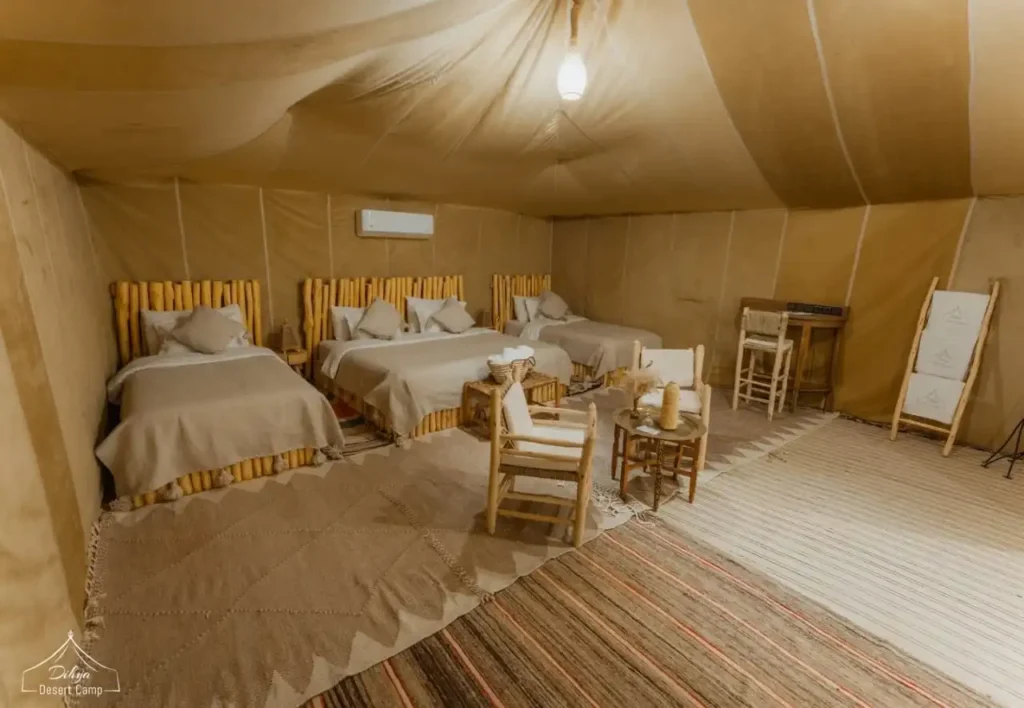
- In the Sahara, private tents in Erg Chebbi or Erg Chigaga are fully suitable for couples; ask for a double bed rather than twin beds when you book.
Romantic trips we recommend for couples
Timing matters as much as the hotel. Spring (March to May) and autumn (late September to November) bring warm days and cool nights that suit long rooftop dinners and desert evenings. Winter is lovely in Marrakech but very cold at night in the Atlas and the Sahara, while July and August are hot inland. If your dates fall during Ramadan, expected around February 8 to March 9, 2027, restaurants in the medinas may open later and some close at lunch, but riads still serve breakfast and dinner to guests, and the evening atmosphere after iftar is wonderful.
Couples who want time together without worrying about logistics often choose a private tour, where every hotel has been checked in advance. Some favorites with our guests:
- 4-day Marrakech to Merzouga desert tour: Atlas passes, Ait Benhaddou, the Dades Gorges and a night under Sahara stars.
- 8-day luxury desert tour from Casablanca: boutique riads and a premium desert camp.
- Private Marrakech tours: day trips to Ourika, Essaouira and the Agafay desert with sunset dinner.
Plan your trip with a local team
Unmarried, mixed or same-sex, you deserve a trip where nobody spoils your evening at check-in. Our team in Marrakech checks each hotel and camp in advance and arranges private drivers, so you can simply enjoy Morocco together. Send us your dates and travel style through our booking request form and we will reply with a tailor-made itinerary.
Frequently Asked Questions
Can unmarried foreign couples stay in the same hotel room in Morocco?
Yes. When both partners are foreign nationals, hotels, riads and desert camps in Morocco routinely accommodate unmarried couples in a double room. Staff register both passports for the police form, as they do for every guest, but they do not normally ask about marital status. Questions about marriage certificates have historically targeted couples that include a Moroccan national.
Do Moroccan hotels still ask for a marriage certificate?
Officially, the requirement was relaxed in 2024, and Morocco’s justice minister said hotel staff should not ask guests about marital status. In practice, some hotels, especially smaller ones, may still ask couples that include a Moroccan national for a marriage contract. Article 490 of the penal code has not been repealed, so confirm the policy with your hotel in writing.
Can a foreigner and a Moroccan stay together in a hotel?
Often yes, particularly in international chain hotels and well-established riads in big cities, but it is not guaranteed. Some properties may still ask for a marriage certificate when one guest checks in with Moroccan identity documents, including dual nationals. Write to the hotel before booking, keep the reply, or book through a local agency that checks in advance.
Is kissing in public allowed in Morocco?
Holding hands and a brief kiss on the cheek are generally fine in cities and tourist areas. Prolonged kissing or intimate behavior in public is considered offensive and can attract comments or police attention, particularly in small towns, near mosques and during Ramadan. Inside your riad, at the pool or in a private desert tent, normal affection is fine.