Morocco can be one of the best-value trips from Europe, North America or the Gulf, or one of the most indulgent, depending on how you travel. The same evening in Marrakech can cost 60 dirhams for a bowl of harira and grilled skewers in Jemaa el-Fna, or several thousand for a rooftop dinner and a suite in a restored palace riad.
Want a fixed price instead of a budget spreadsheet? Our Morocco tours include your driver, riads and desert camp in one quote.
This guide sets out a realistic Morocco travel budget for 2027, based on what our team in Marrakech sees travelers spend every day. Prices are honest approximate ranges, not promises: they move with season, exchange rates and how hard you bargain. As a rough guide, in late 2026 one US dollar buys about 10 Moroccan dirhams (MAD) and one euro about 11 MAD.
Quick answer: In 2027, plan on roughly 400–700 MAD (about 40–70 USD or 37–64 EUR) per person per day for a backpacker trip, 1,000–2,000 MAD (about 100–200 USD or 90–180 EUR) for mid-range travel, and from around 3,500 MAD (about 350 USD or 320 EUR) per day for luxury riads, private drivers and premium desert camps.
Morocco travel budget per day: three styles compared
These daily figures are per person, sharing a double room, and exclude international flights. They include accommodation, food, local transport and a moderate amount of sightseeing.
| Travel style | Per person per day (MAD) | Approx. USD | Approx. EUR | What it looks like |
|---|---|---|---|---|
| Backpacker | 400–700 | 40–70 | 37–64 | Hostel dorm or simple guesthouse, street food, trains and buses, shared desert tour |
| Mid-range | 1,000–2,000 | 100–200 | 90–180 | Charming riad with breakfast, sit-down restaurants, some private transfers or a private tour |
| Luxury | 3,500+ | 350+ | 320+ | Boutique or palace riad, fine dining, private driver and guide, luxury desert camp |
Marrakech is generally the most expensive city, while Fes, Chefchaouen and the southern valleys are cheaper day to day. A Sahara trip is usually the single biggest line in any budget, so we cover it separately below.
Accommodation costs: hostels, riads and luxury stays
Staying in a riad, a traditional house built around a courtyard, is one of the highlights of Morocco and is available at every price point.
- Hostel dorm bed: typically 100–200 MAD (10–20 USD) per night, often with breakfast on a roof terrace.
- Simple guesthouse or budget riad (double room): around 300–600 MAD (30–60 USD) per night.
- Mid-range riad (double room): typically 800–1,800 MAD (80–180 USD) per night, with breakfast and often a plunge pool.
- Luxury riad or palace hotel: from around 3,000 MAD (300 USD) to well over 8,000 MAD (800 USD) per night.
- Kasbah hotels in the south: in Ait Benhaddou, the Dades Valley or Skoura, good rooms with dinner and breakfast often cost less than equivalent city riads.
Expect a small tourist tax on top, collected per person per night. It ranges from a few dirhams at small guesthouses to around 45 MAD at luxury hotels, and is sometimes paid in cash at checkout.
Food and drink prices in Morocco
Eating well is cheap in Morocco if you follow local habits. Lunch is often the main meal, and a set menu is usually better value than ordering from a long tourist menu.
| Item | Typical price (MAD) | Approx. USD |
|---|---|---|
| Harira soup or bissara at a local stall | 5–15 | 0.50–1.50 |
| Mint tea in a café | 10–25 | 1–2.50 |
| Fresh orange juice in Jemaa el-Fna | 5–15 | 0.50–1.50 |
| Tagine or couscous in a local restaurant | 40–80 | 4–8 |
| Three-course meal in a mid-range restaurant | 150–300 | 15–30 |
| Dinner at a high-end riad or rooftop restaurant | 400–800+ | 40–80+ |
| 1.5 liter bottle of water | 6–10 | 0.60–1 |
Alcohol is available in licensed hotels, restaurants and some supermarkets, but it is relatively expensive and taxed heavily. A beer in a bar often costs 40–80 MAD, and a bottle of Moroccan wine in a restaurant from around 250 MAD. Skipping alcohol is the easiest way to keep a mid-range budget under control.
Transport costs: trains, buses, taxis and private drivers
Trains
Morocco’s national rail operator ONCF runs comfortable trains linking Tangier, Rabat, Casablanca, Fes and Marrakech, including the high-speed Al Boraq between Tangier and Casablanca in about two hours and ten minutes. Second-class Al Boraq fares typically range from around 100 to 225 MAD depending on how early you book, and Marrakech to Fes (around seven hours) is often in the 200–300 MAD range in second class. Check timetables and fares on the official ONCF Voyages booking site.
Buses
CTM and Supratours operate reliable long-distance coaches, with most intercity routes typically between 100 and 300 MAD. Book a day ahead in high season, and expect a small extra charge for large bags.
Taxis
Small city taxis (petits taxis) are cheap: most rides within Marrakech or Fes cost around 20–50 MAD, though drivers do not always use the meter, so agree on the fare first. Airport taxis cost more, typically around 150–250 MAD into central Marrakech.
Private driver
Many visitors find that a private driver is the best value for a multi-stop trip, especially for families or small groups splitting the cost of one vehicle. It saves hours of connections, and roads to the Sahara, the Dades Valley and the Atlas are not well served by public transport. A private tour is usually priced per vehicle or per group, so the per-person cost falls quickly with three or four travelers.
Sahara desert tour costs
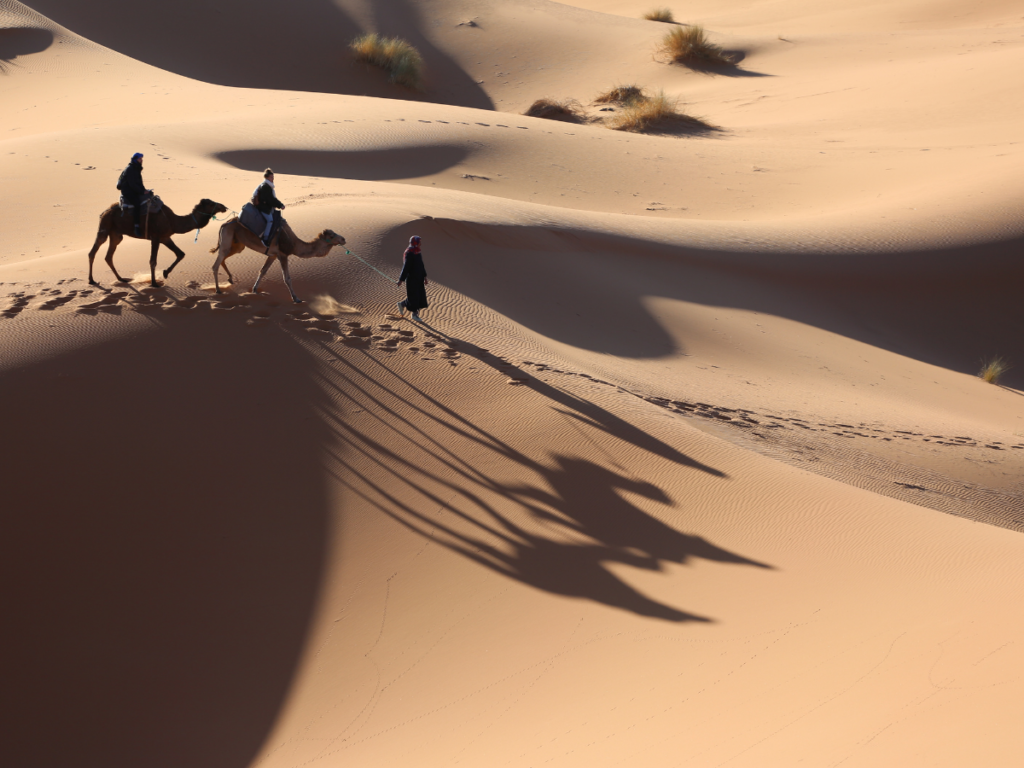
For most travelers, a night in the dunes of Erg Chebbi near Merzouga or Erg Chigaga is the highlight of the trip, and it is worth budgeting for properly. The main choice is between shared group tours and private tours.
- Shared 3-day group tour from Marrakech: typically around 80–200 USD per person, with a large minibus, fixed stops and a standard camp.
- Private 3-day tour from Marrakech: commonly around 200–350 USD per person for two travelers, with your own driver, flexible stops and better camp options.
- Luxury desert camp upgrade: private tents with en-suite bathrooms can add roughly 100–300 USD or more per night.
- Extras: sandboarding, quad bikes or a 4×4 trip around the dunes are usually paid locally.
Our 3-day Marrakech to Merzouga desert tour is the most popular way to fit the Sahara into a one-week trip, and our guide to desert activities in Merzouga explains which extras are worth it.
Sightseeing, guides and other daily costs
- Jardin Majorelle, Marrakech: around 170 MAD per adult for the garden, with separate tickets for the museums.
- Palaces, medersas and monuments: most are typically 30–100 MAD.
- Licensed local guide: a half-day medina tour typically costs around 400–800 MAD per group. Always use official guides, recognizable by their badge.
- Hammam: a local public hammam costs very little, while a spa hammam with scrub and massage usually runs 300–800 MAD.
- Cooking class: often around 500–900 MAD per person including the meal.
- SIM card or eSIM: roughly 100–200 MAD for a generous data bundle.
Tipping in Morocco: what to budget
Tipping (often called baksheesh) is part of daily life and is expected for good service. Small coins and 10, 20 and 50 MAD notes are essential, so break large notes in supermarkets or at your riad.
- Restaurants: around 10 percent in sit-down restaurants; round up in cafés.
- Riad staff: 20–50 MAD per night for housekeeping, left at the end of your stay.
- Porters: 10–20 MAD per bag.
- Local guides: typically 100–200 MAD per person for a full day, less for a half day.
- Private drivers: many groups give around 100–200 MAD per day, depending on group size and service.
- Camel handlers: 50–100 MAD per group is appreciated.
- Photos with performers in Jemaa el-Fna: agree a small amount, often 10–20 MAD, before taking pictures.
Money tips to stretch your Morocco travel budget
- Cash is king. Cards work in hotels and larger restaurants, but souks, taxis and small cafés are cash only. ATMs are easy to find in cities and larger towns.
- Bring euros or US dollars to exchange, not Australian dollars, which Smartraveller notes cannot be exchanged in Morocco.
- Change leftover dirhams before you fly. The dirham is a closed currency and cannot legally be taken out of the country; Smartraveller’s Morocco advice explains the currency rules.
- Travel in shoulder season. Late November, January to February (excluding holidays) and June can be cheaper than Easter, October and the Christmas to New Year peak.
- Bargain politely in the souks. Start well below the first price, keep it friendly, and only negotiate if you intend to buy.
- Mind Ramadan. Ramadan is expected to begin around February 8, 2027. Prices do not rise, but some restaurants close during the day.
For more practical planning tips, see our Morocco travel guide.
Plan your trip with a local team
The smartest Morocco travel budget is one built around what matters most to you, whether that is a once-in-a-lifetime luxury camp or more nights exploring the medinas. As a locally owned company in Marrakech, we work directly with our own drivers, licensed guides, riads and camps, so we can give you transparent pricing and suggest where to save and where to splurge.
Take a look at our private Morocco tour packages, then request a free, tailor-made quote with your dates, group size and budget.
Frequently Asked Questions
How much does a trip to Morocco cost per day?
In 2027, a backpacker can travel on roughly 400 to 700 MAD (about 40 to 70 USD) per person per day. Mid-range travelers typically spend 1,000 to 2,000 MAD (about 100 to 200 USD), and luxury travelers from around 3,500 MAD (about 350 USD). Flights, desert tours and shopping are usually budgeted separately.
Is Morocco expensive for tourists?
Morocco is generally affordable compared with Europe, North America or the Gulf. Local food, trains and taxis are cheap, and good riads cost less than similar boutique hotels elsewhere. Costs rise with luxury riads, alcohol, private guides and premium desert camps, and Marrakech is usually pricier than Fes or the southern valleys.
How much should I tip in Morocco?
Tipping is customary. Leave around 10 percent in sit-down restaurants and round up in cafés. Porters usually get 10 to 20 MAD per bag, riad staff 20 to 50 MAD per night, and local guides about 100 to 200 MAD per person for a full day. Many groups tip private drivers 100 to 200 MAD per day.
Should I bring cash or use cards in Morocco?
Bring both, but rely mostly on cash. Cards are accepted in hotels, larger restaurants and some shops, while souks, taxis and small cafés are cash only. ATMs are widely available in cities. Dirhams cannot legally be taken out of Morocco, so exchange leftovers before departure and keep your exchange receipts.