Packing for Morocco usually starts with the big questions: which cities, how many nights in the Sahara, what to wear in the medina. Then, the night before your flight, someone asks the small question that can ruin a day: will my charger actually work there? Choosing the right Morocco travel adapter takes two minutes once you know the plug shape and the voltage, and it saves you from hunting for one in the souks.
Our team in Marrakech meets travelers from the USA, the UK, Australia, the Gulf and Asia every week, and dead phones on day one are one of the most common (and most avoidable) problems we see. This guide covers sockets, voltage, adapters versus converters, and the real-world charging situation in riads, kasbahs and desert camps.
Quick answer: Morocco uses Type C and Type E sockets, the same two-round-pin plugs used in France and most of continental Europe, with a supply of about 220–230 volts at 50 Hz. Travelers from the US, UK, Australia and most of the Gulf need a simple plug adapter; only single-voltage 110–120V appliances also need a converter.
Morocco plug type and voltage at a glance
Morocco follows the French electrical standard, a legacy of the protectorate period. You will find two socket styles, and both accept the same slim two-pin European plug. The International Electrotechnical Commission keeps a reliable reference on its World Plugs guide to plug types by country if you want to double-check before you buy.
| Item | What Morocco uses |
|---|---|
| Plug and socket types | Type C (two round pins, ungrounded) and Type E (two round pins plus a grounding pin in the socket) |
| Compatible plugs | Type C, E and F (the German Schuko plug fits Type E sockets) |
| Voltage | About 220–230V |
| Frequency | 50 Hz |
| Same as | France, Spain, Belgium and most of mainland Europe |
In practice, almost every socket you meet in a hotel, riad or guesthouse is a round recessed outlet. A European two-pin plug drops straight in. Older buildings in the medinas of Fes and Marrakech sometimes have shallow, loose sockets, so a heavy plug can fall out; more on that below.
Which Morocco travel adapter do you need by country?
Your adapter choice depends entirely on the plug you bring from home. Here is a simple breakdown for the travelers we host most often.
USA and Canada
American and Canadian plugs (Types A and B, flat pins) do not fit. You need a US-to-European adapter with two round pins. Check your devices for voltage too, because the US grid runs at 120V and Morocco at roughly double that.
UK and Ireland
The three-pin Type G plug does not fit Moroccan sockets. A UK-to-EU adapter is all you need; British voltage (230V) matches Morocco, so no converter is required.
Australia and New Zealand
Type I angled pins will not fit. Bring an AU/NZ-to-European adapter. Voltage is similar to home (230V), so your chargers and hair tools will work.
Gulf states, India and Asia
Travelers from the UAE, Qatar, Saudi Arabia and Bahrain mostly use the UK-style Type G plug, so they need the same UK-to-EU adapter. India uses Types C, D and M; Indian Type C plugs fit directly, while larger Type D and M plugs need an adapter. China, Japan and South Korea each use different shapes; Korean plugs (Type C/F) fit Morocco as they are, while Chinese and Japanese plugs need an adapter, and Japanese 100V-only devices may also need a converter.
- One universal adapter with USB-C ports is the most flexible option if you are combining Morocco with Spain, Portugal or Egypt.
- Bring two adapters if you are traveling as a couple; there is rarely a spare in a desert camp.
- A short extension lead or multi-plug from home (with your own plug type) lets one adapter power several devices.
Adapter or converter: do you need a voltage converter in Morocco?
An adapter only changes the plug shape. A converter (or transformer) changes the voltage. Mixing them up is how hair straighteners melt.
Look at the small print on your charger or appliance. If it says something like INPUT: 100–240V, 50/60Hz, it is dual-voltage and works in Morocco with just an adapter. Nearly all phone, tablet, laptop and camera chargers are dual-voltage today.
- Safe with an adapter only: phone and laptop chargers, camera battery chargers, e-readers, power banks, most electric toothbrush chargers, and travel hair dryers marked dual-voltage.
- Needs a converter (or stay home): US hair dryers, curling irons and straighteners marked 110–120V only, some electric shavers, CPAP machines without a universal power supply, and small kitchen gadgets.
- Our advice: rather than carrying a heavy converter, buy a dual-voltage styling tool or use the hair dryer most mid-range and luxury riads provide on request.
If you travel with medical equipment such as a CPAP, tell us when you book. Our team can check in advance which desert camps and mountain lodges on your route have reliable overnight power.
Charging in riads, kasbahs and city hotels
In Marrakech, Fes, Rabat and Casablanca, power is reliable and outages are uncommon. The challenges in a traditional riad are more about design than electricity.
- Few sockets: restored riads often have only one or two outlets per room, sometimes hidden behind a bed or a carved cedar headboard. A small multi-plug solves this.
- Loose or recessed sockets: chunky all-in-one adapters can sag out of older sockets. A compact adapter with a short cable is more reliable.
- Bathroom outlets: many rooms have no socket near the mirror, so plan where you will dry your hair.
- Courtyard Wi-Fi spots: the best signal is often in the courtyard or on the rooftop terrace, so a charged power bank lets you work over mint tea.
Our drivers keep USB chargers in their vehicles, so on a private tour you can top up between Marrakech and the Atlas, but we still recommend bringing your own cable.
Charging in Sahara desert camps and the Atlas Mountains
This is where a little planning matters most. Desert camps in Erg Chebbi near Merzouga, and in Erg Chigaga near M’Hamid, sit outside the town grid. Most run on solar panels with battery banks, sometimes backed by a generator.
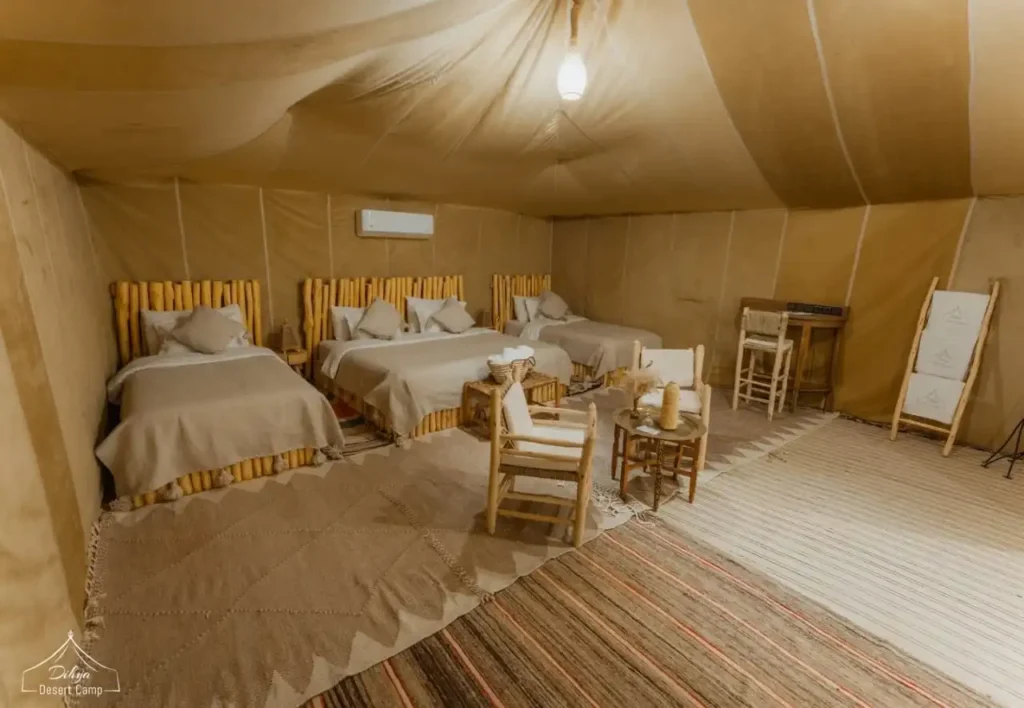
Standard and comfort camps
Simpler camps usually have a shared charging point in the main dining tent or reception, sometimes limited to the evening. Expect one or two power strips for everyone, so arrive with devices already charged.
Luxury desert camps
Higher-end camps typically provide sockets inside each tent, often European two-pin outlets, though power may be lower and occasionally switched off late at night to save the batteries. Avoid plugging in hair dryers or anything that draws high wattage; it can trip the whole system.
Mountain villages and gorges
In Imlil, the Dades Valley, the Todra Gorge and Ait Benhaddou, guesthouses are usually on the grid, but short cuts happen during storms. A power bank is your insurance.
- Charge everything fully the night before you leave for the dunes, usually in your riad or kasbah hotel.
- Carry a 10,000–20,000 mAh power bank; that covers a phone for two to three days of photos.
- Keep your phone in a pocket rather than the car dashboard; desert heat drains and damages batteries.
- Protect ports and cables from fine sand with a zip bag, especially on the camel trek.
- Bring a spare camera battery: sunrise and sunset on the dunes are when you will shoot the most.
If you plan a longer Sahara itinerary such as our 3-day Marrakech to Merzouga desert tour, you will have one night in the dunes and hotel nights on either side, which makes keeping everything charged easy.
Buying a Morocco travel adapter locally
Forgot yours? You can buy adapters in Morocco, but the type you need is the one that converts your plug into a European one, and that is not always stocked.
- Airports: shops at Marrakech Menara and Casablanca Mohammed V sometimes carry travel adapters, at airport prices.
- Medina electronics stalls: in Marrakech near Bab Doukkala or in Fes near Bab Boujloud, small shops sell adapters and multi-plugs, typically for around 20–60 MAD (roughly 2–6 USD/EUR). Quality varies, so avoid adapters that feel loose or hot.
- Supermarkets: Carrefour and Marjane hypermarkets in the new towns stock multi-plugs and extension leads with European plugs.
- Ask your riad: many keep a box of left-behind adapters. Ask politely at reception before buying one.
Our honest tip: buy a good-quality Morocco travel adapter before you leave home. Cheaper local units work for phones, but we would not trust them with a laptop.
Safety tips for electricity in Morocco
- Never force a plug into a socket; if it does not fit, you have the wrong adapter.
- Unplug devices when you leave the room, especially in older riads.
- Do not leave a power bank charging under a pillow or blanket.
- Keep electrics away from hammam steam rooms and pool decks.
- If an outlet sparks or smells hot, stop using it and tell reception.
For broader safety and practical advice before you travel, the UK government’s Morocco foreign travel advice is updated regularly and worth a read whatever passport you hold. You will find more of our own planning tips in our Morocco travel guide and our Morocco travel FAQs.
Plan your trip with a local team
Getting the right Morocco travel adapter is one small piece of a smooth trip. The bigger pieces are pacing, comfortable vehicles, good riads and camps where you sleep well. As a Marrakech-based company, we design private itineraries with our own drivers and local guides, and we will happily tell you exactly what to pack for each stop.
Browse our private Morocco tour packages for ideas, then contact our team in Marrakech to shape a route around your dates, interests and charging needs.
Frequently Asked Questions
What plug adapter do I need for Morocco?
Morocco uses Type C and Type E sockets with two round pins, the same as France. Travelers from the US, UK, Australia, the Gulf, China and Japan need an adapter that converts their plug into a European two-pin plug. Korean and European plugs fit without an adapter, and Indian Type C plugs also fit.
Do I need a voltage converter for Morocco?
Only for appliances that run on 110 to 120 volts alone. Morocco’s supply is about 220 to 230 volts at 50 Hz. Most phone, laptop and camera chargers are dual-voltage, marked 100 to 240V, and need just a plug adapter. Single-voltage US hair dryers and straighteners need a converter or should stay home.
Can I charge my phone in a Sahara desert camp?
Yes, in most camps, though power is limited. Camps near Merzouga and in Erg Chigaga usually run on solar power. Simpler camps have shared charging in the main tent, while luxury camps often have sockets in each tent. Arrive fully charged, carry a power bank, and avoid high-wattage devices like hair dryers.
Can I use UK plugs in Morocco?
Not directly. The UK three-pin Type G plug does not fit Moroccan Type C and E sockets, so you need a UK-to-European adapter. Because both countries use roughly 230 volts, British chargers and appliances work normally once adapted, and no voltage converter is needed for standard UK devices.