Written and reviewed by the Journey Via Morocco travel team in Marrakech. Advisories and entry rules change, so check the official sources linked below before you travel.
If you are heading south, see our private Marrakech tours to the Merzouga desert.
Is Marrakech safe for Americans? Yes. Marrakech is generally safe for American travelers who take normal big-city precautions. The US State Department rates Morocco at Level 2, “Exercise Increased Caution”, because of terrorism risk, and it does not single out Marrakech. What visitors actually meet day to day are scams, persistent touts, pickpocketing in crowds and taxi overcharging, not violent crime.
Marrakech is our home base, and Americans are among the travelers we welcome most often. This guide explains what the official advice really means, the situations US visitors run into in the medina, the US-specific rules worth knowing before you fly, and the practical habits that make a Marrakech trip relaxed rather than stressful.
In this guide
- What the US government says
- The real risks in Marrakech
- Common scams and how to handle them
- Marrakech neighborhoods for visitors
- Rules and tips specific to US travelers
- Practical safety checklist
- Frequently asked questions
Is Marrakech safe for Americans? What the US government says
The US State Department travel advisory for Morocco is Level 2 on its four-level scale: “Exercise Increased Caution” due to terrorism. The advisory covers the whole country; there is no separate, higher warning for Marrakech. Level 2 is the same level the State Department applies to many European countries Americans visit every year.
Morocco has experienced terrorist attacks in the past, and both the US and UK governments advise visitors to stay alert in places popular with tourists. In practice that means being aware of your surroundings in crowded squares and markets, following the instructions of local authorities, and avoiding demonstrations, which occasionally take place in Moroccan cities and are usually peaceful.
| Source | What it says | Type |
|---|---|---|
| US State Department | Morocco: Level 2, Exercise Increased Caution (terrorism) | Official fact |
| UK FCDO | Be vigilant about terrorism; avoid demonstrations | Official fact |
| Marrakech-specific warning | None separate from the country-wide advice at the time of writing | Official fact |
| Everyday problems for visitors | Scams, touts, pickpocketing, taxi fares, mopeds in the medina | Our team’s experience |
What are the real risks for tourists in Marrakech?
Pickpocketing in crowds
Jemaa el-Fna in the evening and the main souk lanes are the busiest places in the city, and the places where pickpockets operate. Keep your phone and wallet in front pockets or a zipped cross-body bag, and be careful when you stop to film the square.
Mopeds and traffic in the medina
Something first-time visitors rarely expect: motorbikes, mopeds and donkey carts share the narrow medina lanes with pedestrians. Walk on one side, keep an ear open for horns and “balak” (watch out), and step aside into a doorway when one comes through. Outside the medina, cross busy roads at lights; drivers do not always stop at zebra crossings.
Taxi overcharging
Marrakech’s beige petit taxis are supposed to use the meter (compteur). Ask for it before you get in, or agree the price first if the driver refuses. Fares are higher at night. From Marrakech Menara Airport, use the official taxi rank and agree the fare, or book a transfer in advance; our Marrakech airport guide explains the options.
Heat and sun
From June to September, afternoon temperatures regularly pass 35°C (95°F). Heat exhaustion is a more common problem for visitors than crime in summer. Sightsee early, rest in the middle of the day, and carry water.
Common Marrakech scams and how to handle them
None of these is dangerous; they are designed to separate visitors from small amounts of money. Knowing the script is usually enough to avoid them.
| Situation | What happens | What to do |
|---|---|---|
| “That way is closed” | A helpful stranger redirects you, then leads you to a shop or asks for a fee | Say “La, shukran” and check your offline map |
| “Berber market, today only” | You are walked to the tanneries or a shop and pressed to pay or buy | Decline; visit tanneries with a licensed guide if you want to see them |
| Henna on Jemaa el-Fna | Henna is applied before a price is agreed, then a high price is demanded | Keep your hands to yourself until the price is fixed, or use a henna salon |
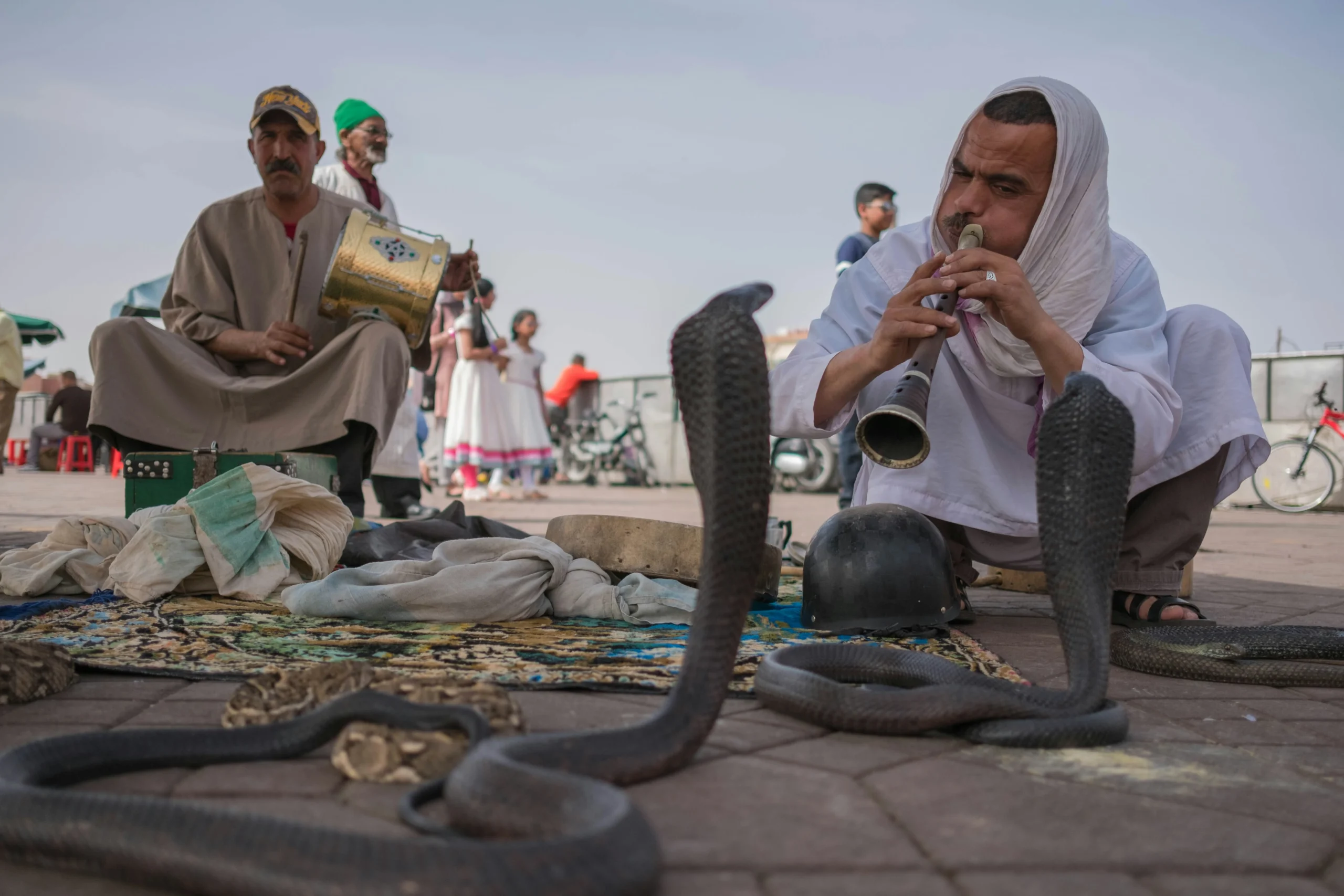
| Photos with snakes, monkeys or performers | A payment is demanded after a photo | Agree the price first or do not photograph; many visitors skip animal photos for welfare reasons |
| Unofficial guides | Someone attaches themselves to you in the souks | Book a licensed guide through your riad; official guides carry a badge |
Which areas of Marrakech are best for visitors?
Official sources do not single out any Marrakech neighborhood, and we do not label areas as dangerous. The difference between districts is atmosphere, ease of navigation and how much attention you will receive.
| Area | What it is like | Best for |
|---|---|---|
| Medina (Jemaa el-Fna, souks, Mouassine, Kasbah, Mellah) | Historic walled city, riads, markets, the busiest and most atmospheric area | First-time visitors who want to be in the heart of things; choose a riad close to a main lane or gate |
| Gueliz | Modern center with wide streets, cafés, galleries, the train station | Travelers who prefer a calmer base and easy taxis |
| Hivernage | Large hotels, restaurants and nightlife between the medina and Gueliz | Hotel stays and evenings out |
| Palmeraie and Agafay | Resorts and desert-style camps outside the city | Relaxed stays with transfers into town |
Is Marrakech safe at night?
Jemaa el-Fna is at its liveliest after dark, with food stalls, musicians and Moroccan families, and Gueliz and Hivernage stay busy in the evening. The quiet back lanes of the medina are where people get lost at night. If your riad is deep in the medina, ask your hosts to meet you at a landmark or to send someone to walk you back.
What should US travelers know before visiting Marrakech?
- Entry: US citizens do not need a visa for tourist stays of up to 90 days. The State Department lists at least six months of passport validity at entry and one blank page. See our Morocco visa requirements guide.
- STEP: enroll in the free Smart Traveler Enrollment Program so the embassy can reach you in an emergency.
- Consular help: the US Consulate General in Casablanca provides services to American citizens in Morocco; the US Embassy is in Rabat. Details are on the State Department’s Morocco country page.
- Drones: do not bring a drone without prior authorization from the Moroccan authorities; customs can confiscate it on arrival.
- LGBTQI+ travelers: Moroccan law criminalizes same-sex sexual relations. Many LGBTQI+ travelers visit without problems, but public displays of affection are best avoided for everyone, and the State Department’s country page has specific guidance.
- Money: the dirham is a closed currency; withdraw from ATMs on arrival and carry small notes. See money in Morocco.
- Insurance: US health plans usually do not cover you abroad. A policy with medical evacuation is worth having; read our Morocco travel insurance guide.
Americans are generally welcomed warmly in Marrakech. Morocco was one of the first countries to recognize the United States, in 1777, and many Moroccans are curious and happy to talk about the US. A few words of Darija go a long way; our guide to the language in Marrakech has the phrases worth learning.
Is Marrakech safe for women traveling alone?
Many American women travel to Marrakech alone or with friends. Unwanted comments in the souks are the most common complaint; they are unpleasant but usually verbal. Modest clothing, confident walking, ignoring comments, and choosing a well-reviewed riad near a main lane all help. Our Morocco travel guide for women has more detail.
Is it safe to take trips from Marrakech to the desert and mountains?
Yes, with sensible planning. The real hazards on these trips are the roads: the Tizi n’Tichka pass over the High Atlas is paved but winding, with heavy trucks and occasional snow in winter, and the drive to the Merzouga dunes takes about nine to ten hours, so it is split over two days. Traveling with an experienced private driver who knows the route, and avoiding night driving in rural areas, removes most of the risk.
Popular options from Marrakech include our 3-day Marrakech to Merzouga desert tour, the more relaxed private 4-day Marrakech to Merzouga tour, and our full range of Marrakech desert tours. For something shorter, compare the Agafay desert and Merzouga.
Practical safety checklist for Marrakech
- Check the latest US and UK advice shortly before you fly.
- Download an offline map and pin your riad; GPS is unreliable in the souks.
- Ask your riad for a meeting point and a phone number before you arrive.
- Agree prices before any service: taxis, henna, photos, guides.
- Keep your passport in the hotel safe and carry a photocopy or photo.
- Avoid demonstrations and large gatherings.
- Save the emergency numbers: police 19, ambulance and fire 15.
Frequently asked questions about Marrakech safety
Is it safe for Americans to travel to Morocco right now?
At the time of writing, the US State Department rates Morocco at Level 2, Exercise Increased Caution, due to terrorism risk. Millions of international visitors travel there each year. Check travel.state.gov shortly before your trip, because advisory levels can change.
Is Marrakech safer than other Moroccan cities?
Official advice does not rank Moroccan cities against each other. Marrakech has more tourists than anywhere else in Morocco, which means more touts and scams in the medina, but also a well-developed tourism infrastructure. See our guides to Tangier safety and the country-wide Morocco safety guide.
Can I drink alcohol in Marrakech?
Yes, in licensed hotels, bars and restaurants. Many traditional riads and medina restaurants do not serve alcohol. Drinking in public is not acceptable, and being drunk in public can lead to trouble with the police.
What should I wear in Marrakech?
There is no legal dress code for visitors, but clothing that covers shoulders and knees is respectful in the medina and draws less attention. Shorts and sleeveless tops are fine at hotel pools and in resort areas.
Do I need a guide in the Marrakech medina?
No, but a licensed guide on your first morning helps you learn the layout and keeps unofficial guides away. After that, most visitors explore on their own with an offline map. Ideas for your days are in our 3-day Marrakech itinerary.
Official sources
- US Department of State: Morocco travel advisory
- US Department of State: Morocco country information
- UK FCDO: Morocco safety and security
- US Smart Traveler Enrollment Program (STEP)
Planning your first trip from the US? Read our Morocco travel guide for Americans, explore our private tours from Marrakech, or contact our team in Marrakech for a tailor-made plan.