
Australians and New Zealanders are some of the most adventurous travelers we host, and they come a very long way to reach us. Australia to Morocco travel means at least one connection and a full day in transit, so the way you plan the journey matters as much as the itinerary itself. Done well, it is the start of one of the most memorable trips you will ever take.
When you are ready to plan the route, browse our Morocco tours with a private driver.
Our team in Marrakech works with Aussie and Kiwi travelers every season, from couples combining Morocco with Europe to families on a once-in-a-lifetime holiday. This guide covers flight connections, visa rules, the inverted seasons, jet lag and the itinerary lengths that make the long flight worthwhile, with links to official Australian and New Zealand government advice.
Quick answer: There are no nonstop flights between Australia and Morocco. Most travelers connect once via Doha, Dubai or Abu Dhabi, or travel via a European hub, taking roughly 22 to 30 hours door to door. Australians and New Zealanders can usually visit visa-free for up to 90 days. Plan at least 10 days on the ground.
Flights: how Australia to Morocco travel works
Morocco’s main international gateways are Casablanca Mohammed V (CMN), Marrakech Menara (RAK) and, for northern itineraries, Fes, Tangier and Rabat. From Sydney, Melbourne, Brisbane, Perth, Adelaide or Auckland, you will connect through either the Gulf or Europe.
| Routing | Typical connection | Good for |
|---|---|---|
| Via Doha | Qatar Airways to Casablanca; Marrakech has also been served | One-stop trips from most Australian capitals |
| Via Dubai | Emirates to Casablanca, then a domestic or rail connection | Wide choice of departure cities including Auckland |
| Via Abu Dhabi | Etihad to Casablanca or Rabat | Alternative Gulf connection; check current schedules |
| Via Europe | Any carrier to Paris, Madrid, Lisbon, London or another hub, then a short flight to Marrakech, Fes or Tangier | Combining Morocco with Spain, Portugal or France |
| Via Asia then Europe | Two-stop itineraries through Singapore, Bangkok or Hong Kong | Points redemptions and stopovers |
Routes and frequencies change every season, so check directly with the airlines. A few things our team has learned from guests over the years:
- Arrive in Casablanca, start in Marrakech. If your long-haul flight lands in Casablanca, a private transfer to Marrakech takes around three hours, or our driver can begin your tour at the airport.
- Use an open-jaw ticket. Fly into Casablanca or Marrakech and out of Fes or Tangier to avoid backtracking.
- Combine with Spain or Portugal. The ferry from Tarifa or Algeciras to Tangier makes it easy to add Andalusia to a Morocco trip.
- Protect your connection. Booking the whole journey on one ticket means the airline is responsible if a delay makes you miss your onward flight.
Visa and entry rules for Australians and New Zealanders
According to the Australian Government’s Smartraveller advice for Morocco, Australians generally do not need a visa for tourist stays of up to 90 days. New Zealand passport holders are also on Morocco’s visa-exempt list for visits of up to 90 days. Entry conditions can change at short notice, so confirm with the Moroccan embassy before you travel.
- Passport: make sure it is valid well beyond your return date; many airlines and countries expect six months.
- Entry stamp: check your passport has been stamped on arrival.
- Overstays can lead to fines or a ban, so plan within the 90 days or arrange an extension through the police.
- Consular help: Australia has an embassy in Rabat. New Zealand has no embassy in Morocco, and its nearest office is in Madrid, so New Zealand’s SafeTravel advice is worth reading and registering with before departure.
- Insurance: both governments strongly recommend comprehensive travel insurance that includes medical evacuation and covers every stopover.
Smartraveller currently advises Australians to exercise a high degree of caution in Morocco overall, with higher levels for some border areas far from the usual tourist routes. Our itineraries stay on the well-traveled roads between the imperial cities, the Atlas Mountains and the Sahara.
Money: bring US dollars or euros, not Australian dollars
This is the tip Aussie and Kiwi guests thank us for most. Smartraveller notes that Australian dollars cannot be exchanged in Morocco. The dirham (MAD) is a closed currency, so you cannot buy it at home either.
- Use ATMs in Morocco to withdraw dirhams with a travel-friendly debit card, and tell your bank you are traveling.
- If you want backup cash, bring euros or U.S. dollars, which banks and bureaux de change accept.
- Cards work in hotels and many restaurants, but souks, taxis and small cafés are cash-only.
- You cannot take dirhams out of Morocco, so spend or exchange them before you fly.
Seasons are inverted: when to go from Australia
Morocco’s seasons are the opposite of yours. Your winter is Morocco’s summer, and your summer is Morocco’s winter. That matters for school holidays and annual leave.
| Australian season | Months | Morocco conditions | Our view |
|---|---|---|---|
| Summer | December to February | Morocco’s winter: mild sunny days, cold nights in the desert and Atlas, snow on the high peaks | Great for cities and the Sahara; pack warm layers |
| Autumn | March to May | Morocco’s spring: green valleys, almond and orange blossom, comfortable temperatures | Ideal for a full tour |
| Winter | June to August | Morocco’s summer: very hot inland and in the desert, pleasant on the Atlantic coast | Popular with families; start early and include the coast |
| Spring | September to November | Morocco’s autumn: warm days, date harvest, settled weather | Ideal for a full tour |
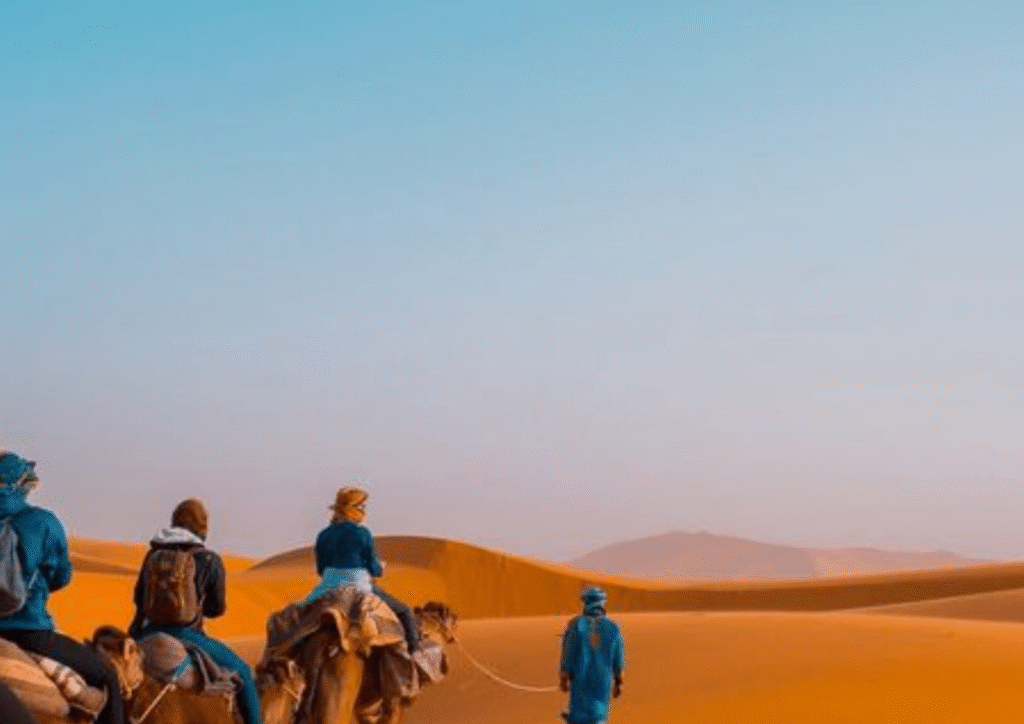
Australians often travel over the Christmas and January holidays. It is a lovely time for Marrakech and the desert, but Sahara nights can drop close to freezing, so our partner camps provide heavy blankets and we recommend a warm jacket and beanie.
Jet lag and the time difference
Morocco moved to permanent GMT (UTC+0) in September 2026, so it no longer changes its clocks. The gap with Australia and New Zealand depends on your daylight saving season:
- Sydney, Melbourne, Canberra, Hobart: 11 hours ahead of Morocco during Australian daylight saving, 10 hours ahead otherwise.
- Brisbane: 10 hours ahead all year.
- Adelaide: 10.5 hours ahead in daylight saving, 9.5 hours otherwise.
- Perth: 8 hours ahead all year.
- Auckland: 13 hours ahead during New Zealand daylight saving, 12 hours otherwise.
How to recover faster
- Book a night or two in a quiet riad before any long drives. We never schedule a desert transfer on arrival day.
- Get outside in the morning light; a slow walk through the Marrakech medina or a garden visit helps reset your body clock.
- Consider a stopover in Doha, Dubai or Europe on the way over if you have the time.
- Stay hydrated on the flight and skip the late-night mint tea for the first couple of evenings.
Health, plugs and packing tips for Aussies and Kiwis
- Plugs: Morocco uses European type C and type E sockets at 220 volts, so your Australian or New Zealand type I plugs need an adapter. Voltage is close to home, so most chargers and appliances work without a converter.
- Health: Smartraveller warns that rabies is present and that food- and waterborne illness is common. Avoid touching stray animals, drink bottled or filtered water, and see a travel doctor about vaccines a few weeks before you leave.
- Sun and layers: the desert sun is strong even in winter, so pack the same sun protection you would at home, plus a fleece for cold Sahara nights.
- Modest clothing: light clothes that cover shoulders and knees are comfortable and respectful in the medinas and villages.
How long to stay: recommended itinerary lengths
After 24 hours or more of travel, a short trip rarely feels worth it. For Australia to Morocco travel, we suggest the following:
- 8 to 10 days: the classic loop of Marrakech, Ait Benhaddou, the Dades Gorge, the Merzouga dunes and Fes. Our 8-day Sahara desert tour from Marrakech is the most popular choice for first-timers.
- 11 to 12 days: add Chefchaouen and the north, perfect if you arrive from Spain. See our 11-day Tangier to Marrakech tour or the 12-day Morocco family holiday.
- 14 to 16 days: the whole country at a relaxed pace, including Essaouira on the coast and quieter mountain valleys.
All of our tours are private, so you can add rest days, swap a city or extend the desert section. Browse our Morocco tour packages for more ideas.
Plan your trip with a local team
Australia to Morocco travel is a big journey, and it deserves an itinerary that respects the jet lag, the seasons and the distances. Our team in Marrakech will match your private tour to your flight times, arrange airport pickups at any hour and suggest the best route for your dates. Send us your plans via our contact page and we will reply with a tailor-made proposal.
Frequently Asked Questions
Is there a direct flight from Australia to Morocco?
No. There are no nonstop flights between Australia and Morocco. Most travelers connect once through a Gulf hub such as Doha, Dubai or Abu Dhabi, or fly to a European city such as Paris, Madrid or Lisbon and continue on a short flight to Casablanca, Marrakech, Fes or Tangier. Total travel time is usually 22 to 30 hours.
Do Australians need a visa for Morocco?
Australians generally do not need a visa to visit Morocco for tourism for up to 90 days, according to Smartraveller. Your passport should be valid well beyond your stay, and you should make sure it is stamped on entry. Entry rules can change at short notice, so check Smartraveller and the Moroccan embassy before you travel.
What is the best time to visit Morocco from Australia?
The most comfortable months are March to May and September to November, which fall in Australia’s autumn and spring. December and January are popular with Australians and fine for cities and the desert, though nights are cold. June to August is very hot inland, so pair the desert with the cooler Atlantic coast.
How much time do you need in Morocco from Australia?
Because of the long journey, we recommend at least 10 days on the ground. That allows one or two days to recover from jet lag in Marrakech, then a loop through the Atlas Mountains, the Sahara at Merzouga and Fes. Two weeks lets you add Chefchaouen, Essaouira or a combined trip with Spain.