
Six days is enough time to see a real cross-section of Morocco, from the Atlantic coast to the blue streets of Chefchaouen, the imperial city of Fes, and a night under the stars in the Sahara. It is a fast-paced route, and I say that honestly upfront rather than after you have booked it. What follows is the exact itinerary I would drive with a private group who has this amount of time and wants cities, mountains and desert in a single trip.
Your 6-Day Morocco Itinerary From Casablanca at a Glance
| Day | Route | Main experiences | Overnight |
|---|---|---|---|
| 1 | Casablanca to Chefchaouen | Hassan II Mosque, Rabat highlights | Chefchaouen |
| 2 | Chefchaouen to Fes | Blue medina, Volubilis ruins | Fes |
| 3 | Fes to Merzouga | Middle Atlas, Ziz Valley, camel trek | Erg Chebbi desert camp |
| 4 | Merzouga to Dades Valley | Desert sunrise, Todra Gorge | Dades Valley |
| 5 | Dades Valley to Marrakech | Skoura, Ouarzazate, Ait Ben Haddou | Marrakech |
| 6 | Marrakech to Casablanca | Free time, private transfer | Departure |
- 6 days, 5 nights
- Private vehicle and driver for the full route
- Best for first-time visitors who want cities and the Sahara in one trip
Day 1: From Casablanca’s Atlantic Coast to Chefchaouen’s Blue Medina
Hassan II Mosque
Your first stop after landing is Casablanca’s Hassan II Mosque, one of the largest mosques in the world and one of the few in Morocco open to non-Muslim visitors. Its position on the Atlantic, with the tide breaking against the retaining wall, makes it worth the visit even for travelers who are not usually drawn to religious sites.
Rabat: Hassan Tower and Kasbah of the Udayas
An hour up the coast, Rabat gives you the Hassan Tower, the unfinished 12th-century minaret, and the whitewashed Kasbah of the Udayas overlooking the river mouth. It is a calmer stop than Casablanca and a good stretch before the longer drive north.
Arrive in Chefchaouen
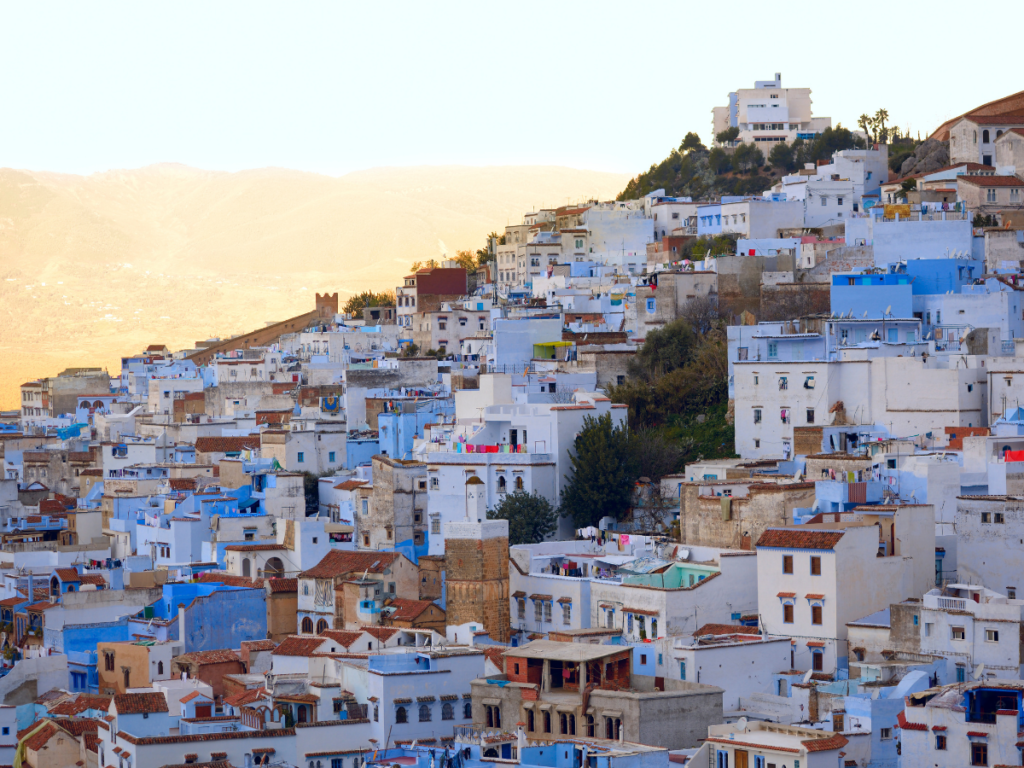
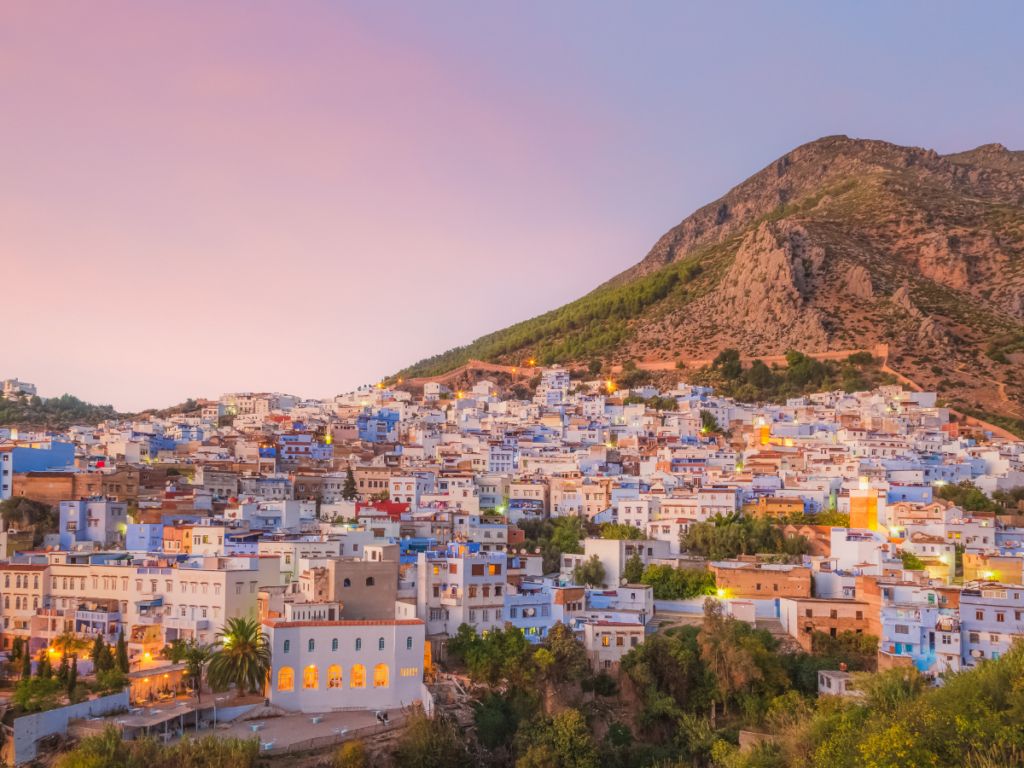
The final leg climbs into the Rif Mountains, and arriving in Chefchaouen as the light drops is one of the better first-day experiences in Morocco. You will have the evening to walk the blue-washed medina before the itinerary picks up pace tomorrow.
Day 2: Chefchaouen, Volubilis and the Imperial City of Fes
Morning in the Blue City
A morning walk through Chefchaouen’s medina, ideally before the day-trip crowds arrive from Tangier and Tetouan, is the best way to see the town’s blue streets and small squares properly.
Explore the Roman ruins of Volubilis
On the way to Fes, Volubilis is Morocco’s best-preserved Roman site, with mosaic floors still visible in what were once wealthy villas. It is a two-hour stop, not a full day, but worth the detour from the direct road.
Arrive in Fes
Fes el-Bali, the old medina, is the largest car-free urban area in the world. Arriving in the late afternoon gives you time to get oriented before a fuller exploration the next morning if your route allows, though on this six-day version, Fes itself is a passing-through stop rather than a multi-day stay.
Day 3: Fes to Merzouga: Crossing the Middle Atlas to the Sahara
Ifrane and the Cedar Forests of Azrou
Ifrane looks more like an Alpine town than anywhere else in Morocco, and the cedar forests around Azrou are home to Barbary macaques that often come close to the road.
Midelt and the changing landscapes
Past Midelt, the terrain shifts from cedar forest to the drier, rockier ground of the High Atlas foothills, a visible change over just a couple of hours of driving.
Ziz Valley
The Ziz Valley’s palm groves, threaded along the river before the true desert begins, are one of the most photographed stretches of this route and a natural place to stop.
Camel trek and sunset in the Erg Chebbi dunes
You will reach Merzouga in the afternoon, in time to leave your vehicle behind and continue by camel into the Erg Chebbi dunes. Watching the sunset from the dunes, followed by dinner and the night in a desert camp, is the centerpiece of this itinerary.
Day 4: Sahara Sunrise, Todra Gorge and the Dades Valley
Sunrise over Erg Chebbi
Waking before dawn to watch the light change over the dunes is worth the early start, and it is a different experience from the previous evening’s sunset, quieter and colder before the sun clears the horizon.
Tinghir and the Todra Gorge
After returning to the vehicle, the drive to Tinghir brings you to the Todra Gorge, where cliffs rise sharply on either side of a narrow river passage, a striking contrast after a full day in open desert.
Discover the Dades Valley
The Dades Valley’s rock formations and kasbah-dotted route make for a scenic overnight stop before the final push toward Marrakech.
Day 5: Dades Valley, Skoura, Ouarzazate and Ait Ben Haddou to Marrakech
Skoura’s palm oasis
Skoura’s palm grove and its older kasbahs give a sense of how these valleys sustained agricultural communities for centuries before modern roads existed.
Ouarzazate: gateway to the Sahara
Ouarzazate, known as Morocco’s film studio hub, is also a natural rest point on the route between the desert and the High Atlas.
Ait Ben Haddou UNESCO World Heritage Site
Ait Ben Haddou, the best-preserved fortified ksar in southern Morocco, is one of the highlights of this itinerary. Walking through its passages and up to the granary at the top is worth an hour or more before continuing.
Cross the High Atlas via Tizi n’Tichka
The Tizi n’Tichka pass, one of the highest paved roads in Morocco, is the final stretch before descending into Marrakech, with views back across the mountains you have just crossed.
Day 6: Marrakech to Casablanca
Free time in Marrakech
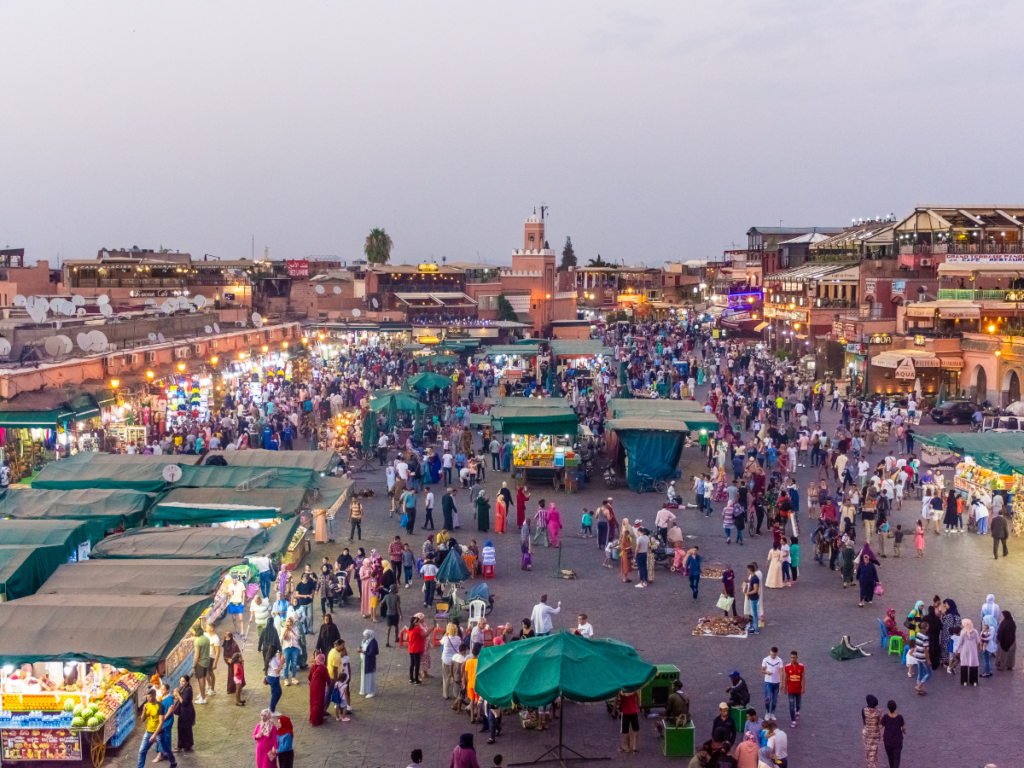
Depending on your flight time, you will have some hours in Marrakech, enough for the Jemaa el-Fnaa square or a walk through the nearby souks before departure.
Private transfer to Casablanca
The drive back to Casablanca closes the loop, with your private driver handling the transfer rather than a shared shuttle or train connection.
Airport or hotel drop-off
Drop-off is arranged directly at the airport or your hotel, depending on your onward plans.
What Makes This 6-Day Morocco Itinerary Casablanca Different?
This route is built around private travel, not a large group bus schedule, which means stops can be adjusted for weather, pace or personal interest along the way. It combines cities, mountains and the Sahara in a single trip rather than focusing on just one region, using local knowledge to choose stops that are worth the time rather than rushing between every marked attraction on a map, at a pace that can flex if you want longer in one place and less in another.
What’s Included in This Morocco Tour
- Private vehicle and driver for the full 6 days
- All accommodation as listed, including one night in a desert camp
- Camel trek in the Erg Chebbi dunes
- Entry fees at Volubilis and Ait Ben Haddou
- Airport and hotel transfers
What’s Not Included
- International flights
- Meals not specified in the itinerary
- Personal expenses and tips
- Travel insurance
- Optional activities outside the core route
Where Will You Stay?
Accommodation on this route mixes comfortable riads and hotels in Chefchaouen, Fes and Marrakech with one night in a Sahara desert camp near Erg Chebbi. The camp can be arranged as a shared or private setup depending on your preference, and city stays are chosen for their location relative to each day’s route rather than the largest or most generic hotel available.
How Much Driving Is Involved?
I will not soften this part. The Fes to Merzouga leg and the Dades to Marrakech leg are both long driving days, several hours each, crossing mountain passes rather than flat highway. A private vehicle makes this manageable because you can stop when you want, rather than staying fixed to a bus schedule, and the driver knows the route well enough to break up the longer stretches at worthwhile points rather than driving straight through.
Is 6 Days Enough for Morocco?
Yes, if your priority is hitting the highlights: the north, the imperial cities and the Sahara, in one trip. It is a fast-paced itinerary with two genuinely long driving days, so if you would rather spend more time in each place and less time in the vehicle, 7 to 8 days gives the same route more breathing room.
Best Time to Take This 6-Day Morocco Tour
Spring brings mild temperatures across the whole route, from the mountains to the desert, and is one of the strongest windows for this itinerary. Autumn offers similar conditions and is a close second choice. Summer is hot in the Sahara and the lower valleys, though the Rif Mountains around Chefchaouen stay more comfortable. Winter is mild in the cities but genuinely cold at night in the desert camp, so pack layers if you are traveling this route between December and February.
Practical Tips for Your Morocco Itinerary
Pack layers rather than a single warm coat, since temperatures shift sharply between the desert, the mountains and the coast on this route. Desert nights are cold even when the daytime heat is intense, so a warm layer for the camp matters regardless of season. Comfortable walking shoes are more useful than anything else you pack, given the amount of medina and uneven terrain covered over six days. Carry cash for smaller towns and markets, since card acceptance drops outside the larger cities. Modest dress is appreciated in medinas and rural areas, and long driving days are part of this itinerary rather than an inconvenience to avoid, so pace your expectations accordingly.
Frequently Asked Questions About a 6-Day Morocco Itinerary
What are the best places to visit in Morocco in 6 days?
For a six-day Morocco trip, the strongest combination is Casablanca, Chefchaouen, Fes, Merzouga and the Sahara Desert, followed by the Dades Valley, Ouarzazate and Aït Ben Haddou. This route combines Morocco’s imperial cities, Rif and Atlas Mountains, desert landscapes, historic kasbahs and traditional Berber culture.
Can I visit Chefchaouen, Fes and the Sahara in 6 days?
Yes. A well-planned 6-day Morocco itinerary can include Chefchaouen, Fes and Merzouga, but the trip is fast-paced. The most efficient option is a private tour with a dedicated vehicle and driver, allowing you to make scenic stops and follow a route that connects northern Morocco with the Sahara.
Is a 6-day Morocco itinerary too rushed?
A 6-day Morocco itinerary is ideal for travelers who want to see the highlights in a limited time, but it involves several long driving days. This route is best for travelers comfortable with road travel. For a slower experience with more time in Fes, Chefchaouen and the Sahara, consider extending the trip to 7 or 8 days.
Can I customize this 6-day Morocco itinerary?
Yes. A private Morocco itinerary can be customized around your travel dates, arrival and departure points, accommodation level, interests and preferred pace. You can also adjust the number of nights in Chefchaouen, Fes or the Sahara, or extend the journey to create a more relaxed Morocco tour.
Can I start and end this Morocco itinerary in Casablanca?
Yes. This route is designed to start and finish in Casablanca, making it convenient for travelers arriving at or departing from Mohammed V International Airport (CMN). The itinerary travels through northern Morocco, Fes and the Sahara before returning to Casablanca via Marrakech.
Ready to Make This Morocco Trip Your Own?
Six days can be enough to see Morocco’s highlights—but your trip shouldn’t feel rushed. Want more time in Chefchaouen, Fes or the Sahara?This route includes 1 night in the Erg Chebbi desert, with a sunset camel trek and an unforgettable night at a Sahara camp. Tell us your travel dates and priorities, and we’ll tailor the route around you.
Travel privately with your own driver and vehicle from start to finish.
