Morocco looks compact on a map, but distances add up quickly once the High Atlas sits between you and the Sahara. Getting around Morocco well is the difference between a relaxed trip and one spent in bus stations, so it is worth understanding the options before you book a single riad.
Our drivers spend their lives on these roads, and our team in Marrakech books trains, buses and transfers for guests every day. Here is our practical 2027 guide to ONCF trains (including the Al Boraq high-speed line), CTM and Supratours buses, grand and petit taxis, car rental and private drivers, with realistic journey times and approximate prices.
What is the best way of getting around Morocco? Use trains between the big northern and Atlantic cities (Tangier, Rabat, Casablanca, Fes, Marrakech), with the Al Boraq high-speed train on the Tangier to Casablanca stretch. For the Atlas Mountains, the Sahara and small villages, where there are no railways, a private driver or a long-distance CTM or Supratours bus works best.
Getting around Morocco: quick comparison table
Typical journey times and one-way costs for popular routes. Prices are approximate and vary with season, class and how early you book.
| Route | Best option | Approx. time | Approx. cost |
|---|---|---|---|
| Tangier to Rabat | Al Boraq train | 1 h 20 min | 90-225 MAD |
| Tangier to Casablanca | Al Boraq train | 2 h 10 min | 100-300 MAD |
| Casablanca to Marrakech | Al Atlas train | 2 h 45 min-3 h | 135-215 MAD |
| Rabat to Fes | Train | 2 h 50 min-3 h | 115-175 MAD |
| Fes to Marrakech | Train (direct) | About 7 h | Around 200-330 MAD |
| Marrakech to Essaouira | CTM or Supratours bus | About 3 h | Around 90-110 MAD |
| Marrakech to Merzouga | Private driver (overnight stop) or bus | 9-10 h driving; longer by bus | Bus around 230-280 MAD; private tour priced per itinerary |
| Fes to Merzouga | Private driver or bus | 7-8 h driving; longer by bus | Bus around 200-250 MAD |
| Marrakech to Agadir | CTM or Supratours bus | About 3 h 30 min | From about 120 MAD |
Exchange rate guide: 10 MAD is roughly 1 EUR or slightly over 1 USD.
Trains: ONCF and the Al Boraq high-speed line
Morocco’s national railway, ONCF (Office National des Chemins de Fer), runs a clean, punctual and affordable network linking Tangier, Rabat, Casablanca, Fes, Meknes, Marrakech and Oujda. Tickets can be booked on the official ONCF Voyages booking site up to about three months ahead, through the ONCF app, or at stations. Some foreign cards are declined online; if that happens, buy at the station a day or two before.
Al Boraq: Africa’s first high-speed train
Al Boraq runs at up to 320 km/h between Tangier and Kenitra, then continues on upgraded track to Rabat Agdal and Casablanca Casa Voyageurs. Trains run roughly hourly from early morning to evening. Tangier to Casablanca takes about 2 hours 10 minutes, compared with almost 5 hours before it opened.
Is the Kenitra to Marrakech high-speed extension open? Not yet. Construction of the new line, which will link Rabat and Casablanca to Marrakech, began in 2025. In May 2026 Morocco’s transport minister said the project was over 30% complete and on track for delivery around September 2029, ahead of the 2030 FIFA World Cup. Until then, trains between Casablanca and Marrakech use the conventional Al Atlas service, which is comfortable and takes under three hours.
Train tips from our team
- First class is worth the small extra cost on busy Friday and Sunday trains and during holidays; seats are reserved.
- On Al Boraq, all seats are assigned, so book ahead on weekends and around Eid.
- Casablanca has several stations: Casa Voyageurs for long-distance trains, Casa Port near the old medina.
- There is no railway to the Sahara, Ouarzazate, Chefchaouen, Essaouira or Agadir. Plan buses or a driver for these.
Long-distance buses: CTM and Supratours
Where the railway stops, buses take over. The two premium companies are CTM, the national bus company, and Supratours, operated by ONCF and often timed to connect with trains. Both offer air-conditioned coaches, reserved seats and a small luggage fee (usually a few dirhams per bag).
- CTM covers almost every town, including Chefchaouen, Essaouira, Ouarzazate, Zagora and Merzouga, and has its own stations in most cities.
- Supratours is strong on routes from Marrakech to Essaouira, Agadir and the south, and sells combined train and bus tickets.
- Book online or at the company’s office a day or two ahead in high season, especially for Chefchaouen and Essaouira.
- Avoid unknown local bus companies for long routes; they are cheaper but slower and less comfortable.
Night buses exist on the longest routes, such as Marrakech or Fes to Merzouga and Tangier to Marrakech. They save a hotel night, but you arrive tired and miss the scenery of the Atlas and the Ziz Valley, which for many travelers is half the point of the journey. A local tip: buses to Merzouga often arrive late at night or very early in the morning. If you go this way, arrange camp pickup in advance.
Taxis: petit taxis and grand taxis
Petit taxis (city taxis)
Small taxis carry up to three passengers inside one city, and each city has its own color: red in Casablanca and Fes, beige in Marrakech, blue in Rabat, light blue in Tangier. They are supposed to use the meter (“compteur”); a short daytime ride usually costs around 10-30 MAD. A night surcharge of about 50% applies in many cities. If a driver refuses the meter, agree on a price before you get in or take the next taxi.
Grand taxis (shared intercity taxis)
Larger cars, usually white or cream, run between towns and leave when every seat is filled. Fares are fixed per seat and very cheap, but six passengers in an older car is not comfortable for long journeys. You can buy all the seats to travel privately. Grand taxis are also used for fixed-price airport runs.
Ride-hailing apps such as Careem, inDrive and Yango operate in some cities, but their legal status is not settled and availability varies, so do not rely on them.
Car rental and driving in Morocco
Renting a car gives freedom and is reasonable value: a small car typically costs around 250-400 MAD per day, with SUVs higher. Main highways (autoroutes) are excellent and tolled. You drive on the right, and many rental companies ask for an International Driving Permit alongside your license.
- Police checkpoints and radar speed checks are frequent; fines are paid on the spot.
- Mountain roads like the Tizi n’Tichka pass are paved but winding, with trucks and occasional snow in winter.
- Do not drive in the medinas; park in guarded parking (look for a “gardien”) and walk.
- Avoid driving after dark in rural areas, where pedestrians, donkeys and unlit vehicles share the road.
- Fuel stations are frequent on main routes but sparse in the deep south; fill up in Errachidia or Ouarzazate.
Australia’s Smartraveller Morocco page also covers road safety and is worth reading before you rent a car.
Private driver: the easiest way to see the Atlas and the Sahara
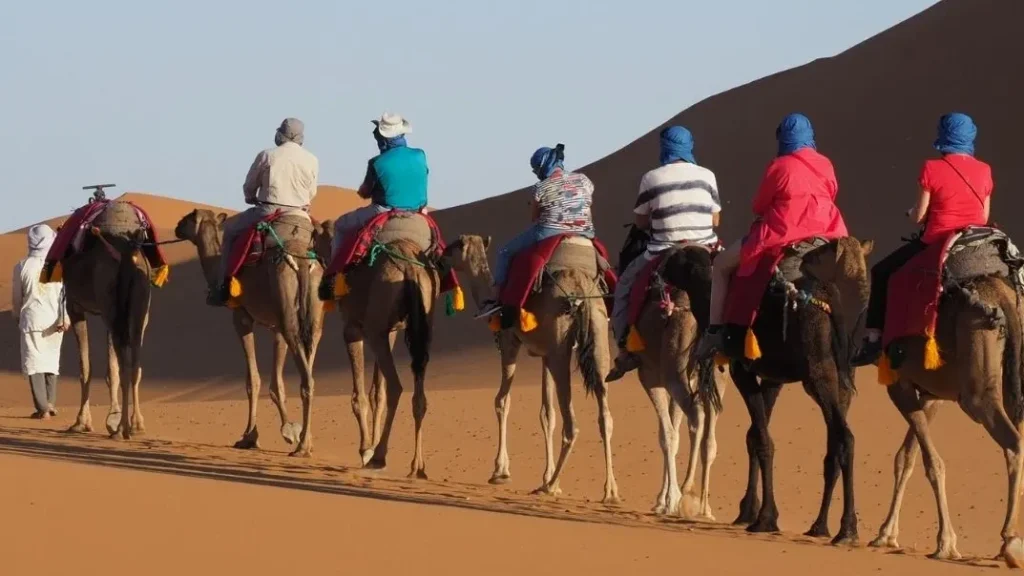
For routes such as Marrakech to Merzouga, Fes to Merzouga or the Atlantic coast, a private driver solves almost every problem: door-to-door pickup at your riad, no bus timetables, stops wherever you want, and a local who can explain the villages and translate in Darija and Tamazight. It is how most of our guests travel.
A private vehicle with driver typically costs around 1,000-1,800 MAD per day (roughly US$100-180), depending on the vehicle, the distance and the season; the price is per car, not per person. For a family or small group, that often comes close to the combined cost of buses, taxis and transfers.
Popular private routes with our drivers include the 2-day private Fez to Merzouga desert tour, the Marrakech to Fes via Merzouga desert tour, and longer loops starting from the north of Morocco in Tangier.
Sample combinations that work well
- Arrive in Tangier: Al Boraq to Rabat or Casablanca, then train to Marrakech.
- Arrive in Casablanca: Train to Fes, private driver Fes to Merzouga to Marrakech, fly home from Marrakech.
- Marrakech base: Bus or day transfer to Essaouira, private driver for the Sahara, train to Casablanca for your flight.
- Short on time: Domestic flights (Royal Air Maroc and low-cost carriers) link Casablanca, Marrakech, Fes, Ouarzazate, Errachidia and Agadir.
Plan your trip with a local team
Getting around Morocco is easy once you know which tool fits which route. If you want our team to stitch trains, transfers and a private driver into one smooth itinerary, browse our private Morocco tour packages or contact our team in Marrakech with your dates for a free tailor-made plan.
Frequently Asked Questions
Is there a high-speed train from Casablanca to Marrakech?
Not yet. Al Boraq currently runs between Tangier, Kenitra, Rabat and Casablanca. A new high-speed line from Kenitra to Marrakech is under construction, with delivery announced for around 2029, before the 2030 World Cup. Today, the conventional Al Atlas train links Casablanca and Marrakech in about two hours and forty-five minutes, at a very reasonable price.
Can you get to the Sahara Desert by train in Morocco?
No. Morocco’s railway does not reach the Sahara, Ouarzazate or the Draa Valley. To reach Merzouga or Zagora, travelers take a CTM or Supratours bus, rent a car, or travel with a private driver. From Marrakech, Merzouga is about nine to ten hours of driving, so most itineraries include an overnight stop in the Dades Valley.
Is it safe to drive in Morocco?
Main highways are modern and well maintained, and many visitors drive in Morocco without problems. Challenges include winding mountain roads, frequent police checkpoints and speed cameras, unpredictable driving in cities, and pedestrians or animals on rural roads, especially after dark. Avoid night driving in the countryside and park outside the medinas in guarded parking.
Is Uber available in Morocco?
Uber no longer operates in Morocco. Apps such as Careem, inDrive and Yango work in some cities, but their legal status is not fully settled and availability varies. Petit taxis remain the standard option for short city trips. They should use the meter, and a typical daytime ride costs around 10 to 30 dirhams.